Tuesday, May 8, 2012

Lambing Concludes


The latest lamb to report is out of Whispering Pines Siena. I rarely hope for ram lambs, but if there was one ewe that I was sort of hoping would have a ram it was Siena. Again, she is on our short list of keeper ewes this year because she has many of the Shetland qualities that we like. She has a nice frame without being too heavy in the bone, and her fleece is both dense and super fine. When she was born, I thought she was the nicest overall lamb that we have ever had here. She is out of Pompey Magnus and Cor de Nuit.
This lamb is the result of careful planning and the crossing of several bloodlines that I think a lot of. We bred Cor de Nuit with Pompey because we thought they complimented each other pretty well. Not to mention the fact that I like the way both lines produce. Siena was the result of that work, and also the first ewe Cor de Nuit gave us. I hadn't planned on breeding her last fall, but elected to do so late. So, to get a lamb at all was a nice bonus. To get one like this is a double bonus.  I think this guy is…the nicest lamb we’ve had born here.


He looks very much like Siena did as a lamb, but given that my expectations increase each year and I still feel that way, that tells me he could be something special. Maybe or maybe not, but he’s as promising as any that we’ve had this year. He should be fully polled as well, which is something that he has that Blue Sapphire’s ram does not.
Another thing I like about some of these lambs (including this one) is something pretty unique, but that probably only matters to me. Some of them have a little horizontal wrinkle across their nose. We’ve never seen that before, but their father has it as well. I like this ram’s father a lot and I think, if nothing else, he’ll have his head. I’ll take that.

Monday, May 7, 2012

Lambing Almost A Wrap


We brought in Sommarang Idelle last fall for three reasons: her structure, her fleece, and her bloodlines. But mostly, I liked her structure. Her conformation is right up there at the top of our flock. As I’ve said before, I won’t bring in sheep unless I’ve seen their parents and I think they are nice. I’m not one for sheep that are aberrations in their bloodline. In my experience, those sheep don’t produce well. Well, Idelle’s mother might be nicer than she is, and her father was nice as well. So, when I see a Shetland that is 20 microns (as Idelle was last fall), I want to know what she is out of. Idelle passed that test.

What I had hoped to do with her was breed her to a super fine ram and see if we could get her great conformation with a fleece that we liked even more. Her moorit ewe lamb this year has that potential. It’ll take some time to determine what she will look like, but she looks promising. Sorry about the pictures, but her mom just doesn't like her near humans when they are out on pasture.
What I can tell you is that she is moorit and spotted. I don't know how fine she will be, of course, but she is quite soft.


It’s no secret that Wintertime Itasca is one of our favorite ewes because: she has a very nice fleece, has nice Shetland type, and throws exceptional lambs. We had her on our initial sales list this year because we had to sell something to get our numbers down, and we felt that we have enough good ewes now that we could do without her. Well, this little moorit ewe lamb is making us think twice about that. When you breed Itasca to super fine rams, she produces. I just love this lamb! She is very feminine and refined. I especially like her head. I think most of our ewes have typey heads, but this one is just what we are after, and it's an attribute that we continue to refine in our program.
Just a beautiful beautiful lamb, who I think will only look better when she fills out.


Saturday, April 28, 2012

Lamb Update


We haven’t had time to do much blogging this spring, so I thought I’d try and do a lamb update to catch up.

This little ewe is out of Sommarang Isla. She is a fine moorit with some nice bloodlines. Isla’s mother was Reserve Champion ewe in 2010, and her father was Grand Champion ram last year under the SSS judges. As I said before, it’s nice to have moorits again. I’ll get better pictures soon (I hope).


This ewe lamb is out of Blue Diamond, one of our top ewes. I also like this little girl a lot. Both her parents are super fine, which certainly doesn’t mean she will be, but I like what I see so far. She was just born the other day, so we’ll update the blog once she fills out some.


Cor de Nuit’s ewe lamb is a very dark brown at this point. Cor always has top notch lambs, and we hope this one will also be. She is a totally different Shetland type than her mother, however. In the past, Cor’s lambs have always had her genetic imprint on them, but this one seems to be more like her father, who is super fine. This is the only picture I could get of her because darkness was descending rapidly. I was checking her over again last night, and I do think there is much potential there now that I've seen her grow for a week.


Constantinople’s ewe lambs. Both are developing nicely. Here us the spotted girl.


Here are both of them using their mother as a jungle gym. That's Madonna's ewe lamb getting in on the action. And yes, Constantinople is the matriarch of the flock, if you couldn't tell. She pretty much decides what goes and what does not.


Here are both of her lambs.They are two of our favorites so far.


Blue Sapphire’s ram is the flashiest we've had in some time. I think I’m going to call him a brandet, as he is the closest I have ever seen a Shetland resemble the color and markings chart. I might change my mind about that.


And this moorit ewe lamb has matured into something I really like!


Only four more ewes left to go. I am a little surprised at the number of singles we’ve had this year, but I don’t really have an explanation for it. I tried some different things last fall to increase the twinning rate, but I can’t say it paid off. We’ll wait until all of the lambs are here before we provide stats and stuff that only people like me would care about. I will say that we are happy to be getting some spots again. We haven’t bred with a spotted ram in quite a few years, and didn't last fall either, so that’s a bit of a surprise. We're not getting flashy spots (Blue Sapphire's aside), but, in reality, it’s just nice to be getting moorits and not so many katmogets. I love the kats, but we needed more shades of brown. Now we could use more blacks.  I'd like to have  two or three black ewes heading into fall.

Wednesday, April 18, 2012

Lambs

Lambing has started here at Whispering Pines, and so far, so good!

This moorit krunet ewe lamb is out of Madonna.


I like this lamb a lot. It looks like she will have a fantastic, crimpy fleece at this point, and we can certainly use more moorits. This is the first pure moorit ewe lamb we’ve had born here in quite a few years. I’m not sure yet which lambs we will keep, but this one is a possibility. And I especially like the fact that both the mother and father are very fine with fleece types that we are after. Madonna’s two-year old spinning fineness was 25.0 with an average 26.0 microns. Her father’s two-year old micron average was 25.6 with a CV of 14.4. I always pick type over numbers, and this lamb looks like she might have both.

Blue Sapphire is one of our favorite adult ewes and we were really anticipating something nice out of her this year. We were disappointed that she only had a single, but this ram lamb is pretty close to what we would have wanted. Sapphire is not a poll carrier, so I would anticipate that this ram will be scurred, but he looks promising thus far. I’ve always said that I don’t consider us a polled breeder because we typically opt to breed with the best Shetlands we can and not be concerned about color, spots, and horns, but we will choose polled if all else is equal.


This guy will be retained for now to see how things develop. We do like his fleece, and we are hopeful that it will be like his mother’s. Her fleece is the most like her dad’s (Blue’s Clues) than any of our other flock members, and we’d like to reproduce it in all of our flock eventually. Her two year-old fleece tested at a spinning fineness of 23.5 with an average of 24.7. I like our spinning fineness numbers to be much lower than the averages.

This ram lamb is an F4 Jericho, which isn’t a large percentage of one of my favorite Shetland rams, but it’s a bloodline that I like a great deal. His father is super fine, so we are hoping this guy is as well, and I think he will be.

I also like his very dark chocolate moorit color. I’m a sucker for dark grey katmogets, but I also like those rich, chocolate moorits as well. Maybe that’s because we have so few of them.

Constantinople is another one of our favorite ewes. Her mother, Salicional was the top Shetland at Jefferson last year, and I have always thought Connie looks very much like her (except taller). Connie has the best Shetland head in our flock, and has thrown some great ewe lambs for us that capture her essence. Both Blue Diamond and Irish Rose are her daughters. So far, we have kept all of her ewe lambs because they are so similar to our vision of what a Shetland should be. I was almost (and the key word is almost) looking for a nice ram from her this year that would allow us to pass her traits on to our flock in a more widespread manner. Well, we didn’t get a son, but we’ll take two more daughters.


The larger one was the first one out of the chute on Sunday with her smaller spotted sister arriving about 30 minutes later. Both are katmogets and we think they are going to be really nice. Fantastic fleeces on both. I guess you don’t really know how lambs will progress, but we like how promising all of this year’s lambs look so far. And, to be honest, we like all of the yearling ewes that we kept from last year’s lambing. Last year’s lambing was a good step forward, and I like how this year’s looks as well.

Constantinople has a very nice grey katmoget fleece. Her four-year old spinning fineness was 26.5 microns, which is right smack in the middle of the fine category. Her average was 27.2. The funny thing about her fleece is that her yearling test was in the low 27’s and it hasn’t increased much in any year since. I’ve found that the majority of Shetland fleeces increase in micron about 10% per year until they plateau at some point. I like the ones that hold steady. These lambs will be finer than their mother by quite a bit. All of Connie’s lambs have been finer than her, but then, we’ve always bred her to super fine rams.

Thursday, December 29, 2011

Fleece Clinic II

Last year we did a fleece clinic on this blog to illustrate some Shetland fleece characteristics that we like. Shetlands come equipped with many fleece types, so don’t take this to be the definitive guide on the breed, but I will attempt to contrast the different types and, at the same time, illustrate some reasons to go with each type.

First of all, it’s not unusual to encounter double-coated Shetlands on your Shetland journey in the US. There is absolutely nothing wrong with a double-coated Shetland. They are common. What you need to determine is what you want to do with the fleece. Below is an example of a double-coated Shetland fleece.

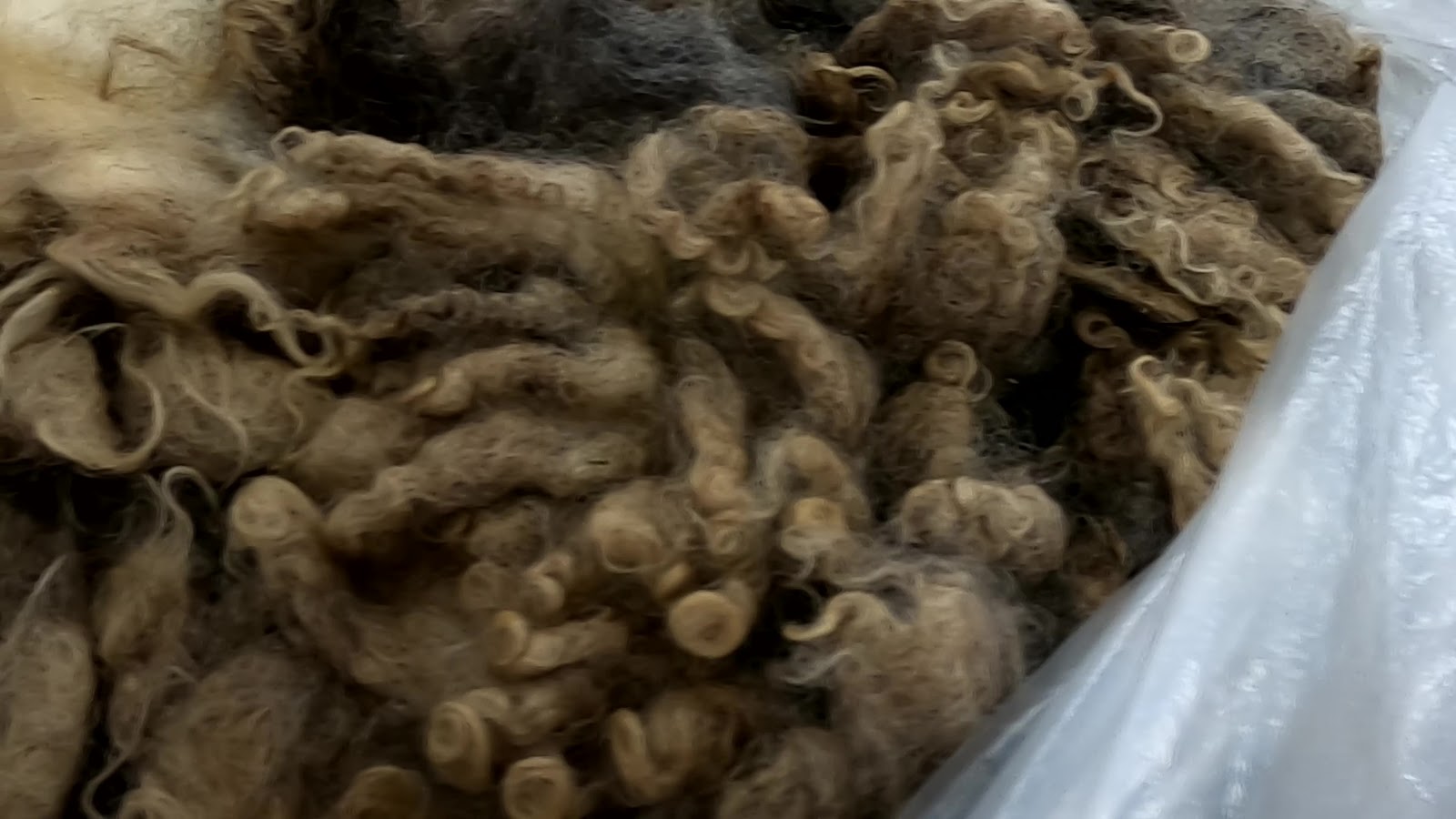
This sample is very straight and coarse. But it has nice luster, which is to say it’s silky. It will spin up very well. But you would never want to use it in next-to-the-skin garments. It’s far too coarse for comfort. And without crimp, it lacks the elasticity that you want for some projects. This particular sample is about 34 microns on average, and the CV is over 30%, but not much over. This fleece is about 9" long.
It is not a breed standard Shetland fleece by any stretch of the imagination, but that doesn’t mean it is bad, necessarily. But I can’t see using it for anything other than rugs. I think it's an example of the type of fleece that starts a lot of arguments between breeders. When you say something does not meet the breed standard, people take exception to it, but, in my opinion, this one doesn't. Why? For one, 34 microns is too coarse. Shetlands are supposed to be fine. Secondly, there is not crimp here. Some might try to argue that it's wavey (which is what the breed standard calls out), but that's equivalent to saying blue is almost green. This fleece has no movement at all in the finished product. It has no elasticity whatsoever.
Now, given that this sample has two very distinct coats, you could easily spend the time to separate them and then the finer inner coat could be used for clothing, but it will still lack the elasticity that you desire. As I said, it comes down to what you want to do with the fleece. But the bigger question might be why would you choose Shetland if you are making rugs and/or other items that require extra durability, without crimp?
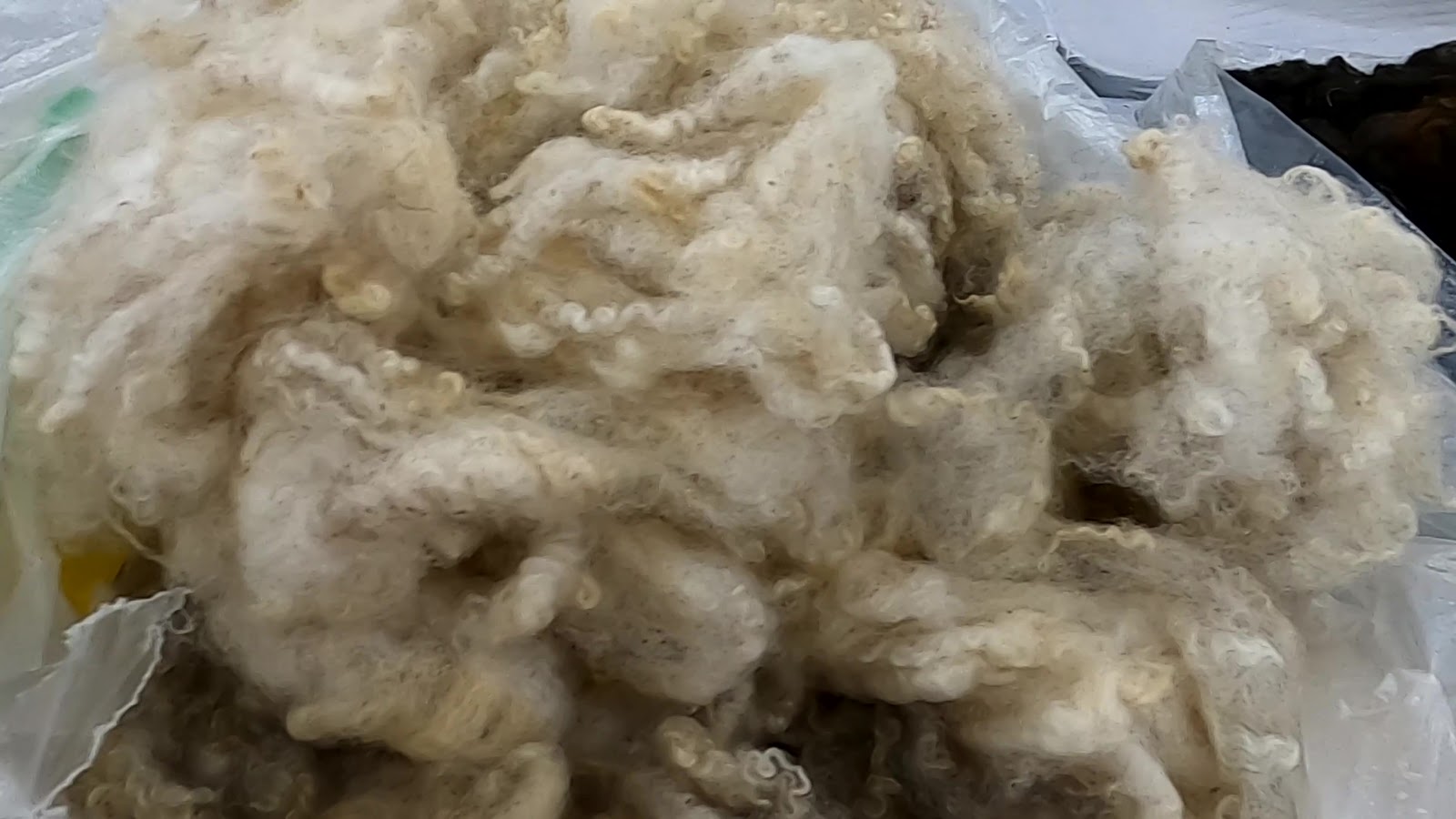
The next sample is also double-coated, but not as extreme. I’ve seen Shetland fleeces ranging from 2” to 16”, and this one is closer to 6”. It has good luster, but also lacks crimp like the first example.


In terms of fineness, it is about 32 microns with a 30% CV. It’s certainly not my ideal, but it is pretty silky, and doesn't feel as coarse as the first sample. You can do a bit more with this fleece than the last one, because the outer coat (guard hair) isn't as dominant, but it still lacks the crimp to really provide good elasticity to projects. And I know there are things you can do during the spinning process to compensate for the lack of crimp, but when you compare it to finer fleeces, there is a very noticeable difference. In terms of spinning properties, it's probably equivalent to the first sample. Both will spin up easily, which makes them a favorite of beginning spinners.
To sum up the first two samples, both are Shetland, but not particularly good examples of the breed. If these fleeces were the norm in the old days in Shetland, the breed would not have been called the finest of the British breeds. That's not to say they didn't exist, however.
Next is a sample of a fleece that I think is a pretty good example from an adult Shetland. You can see distinct crimp here.


The staple is 4", which is what I have found to be a good length. As far as fineness, this one is about 29 microns with a 23% CV. Not bad at all. Nice luster, but not as nice as others that I've seen. Having made products from this fleece, I can say we are pretty satisfied with it. You might say that 29 microns is at the very upper limit of what wool authorities would call fine, and you'd be correct. But you have to evaluate fleeces against multiple criteria, and this one grades out pretty well overall. It has a lot of good properties. And coming from a three-year old ewe, this is not bad at all. There are two coats here, but they would be difficult to separate. If you are into separating the coats, you might be better off with a fleece that contains a more pronounced difference between them. Icelandics have such fleeces and a lot of people like them for that reason.

The next sample is from what I would call a fine fleece. This is basically what we breed for here at Whispering Pines. That doesn't mean anyone else needs to follow what we do, but I'm merely illustrating what we are after.

This fleece falls somewhere between 26 and 28 microns with a 20% CV. It’s about 4” long and you can see the crimp quite clearly. This fleece is fully functional in that is has nice luster and fineness to go along with the other classic Shetland properties. It could be used in most projects, including those requiring extra durability. It really has no limitations for use. It's not as fine as some of the best Shetland fleeces I've seen, but it's very good. This fleece would not need to be separated into two coats because there really aren't two of them.
The final sample is what I would call an extra fine Shetland fleece. It's not Merino fine, but it is still very fine.

In Shetland parlance, an extra fine fleece should have an average micron of between 21 and 24 microns. Some would disagree with my assessment on that, but I’ve seen too many really nice 24 micron fleeces to say that they are not extra fine. And yes, you can notice the difference between one of these fleeces and say an 28 micron Shetland fleece (like the one above). I also don’t think there’s much of a downside to fleeces this fine. I would think you might give up some durability with the really fine stuff, but for years, they used Shetland fleeces in the UK for shawls and other next-to-skin applications. And they were able to do that because of the versatility of the fleeces. It has properties that allow it to be used in many applications. Shetland fleeces are very unique in the totality of their properties. They aren't like Alpaca fiber. They might not be as fine as Alpaca, but they are very durable. Shetland fleeces were commonly used in the hosiery industry back in the day. And that was another thing that made them so unique. They could be used in a demanding application like that, and yet still had excellent fineness. A good Shetland fleece handles like nothing else.
Shetland fleeces can also be quite diverse. The breed itself is very diverse in terms of the various attributes that make up the breed, but fleece is one example of that. I have seen single sheep that had three types of fleeces on one animal. The neck and shoulders were kind of like the good  sample above - very decent - to - good with lots of utility. Not extra fine, but still pretty good. Then by midside, you were into a fleece that resembled the second one from the top. Then, as you moved back a few inches, you were into something more like the top photo. The back half of the sheep really was very limited in terms of what you could do with it. For all intents and purposes, you started out with a three pound skirted fleece and ended up with less than a pound of what I would call decent and reasonably crimpy, and maybe another pound of fleece that wasn’t terribly coarse, but still had limited functionality. That’s just not what we breed for here, but you can find sheep like that without very much difficulty if that's what you like. As I said, it really depends on what you like in your fleeces.
In closing, here are a few other examples of extra fine fleeces with 4" staple lengths and great uniformity. And notice the classic Shetland lock structure on each one.


These fleeces might not be for everyone, but we think they represent the breed nicely. They won't be 6" long, but 3" to 4" is more typical of the breed when you get this fine. If someone can show me a fine and soft Shetland fleece that is longer than 6", I'll be very interested in that fleece. I am sure there are bloodlines like that, but I haven't come across one yet. A 6" fleece can be quite acceptable, but I wouldn't expect it to be this fine. I suppose it could be, but I think this would be the exception to the norm, based on what I have seen.
And maybe that's the final point of this post. You don't have to go super short to get extra fine. The Shetland Sheep Society allows fleeces to be as short as 2" and as long as 6". I don't care for the fleeces at those extremes, but I've seen some good stuff at those ends of the spectrum.

I have been fortunate to have visited 15 Shetland farms over the years, and I have seen a lot of different types of Shetlands and fleeces. That has given me some perspective on the breed that I would not have gained otherwise. It allowed me to really fine tune my craft. And to me, breeding is a craft. It's not easy. It's not hard breeding Shetlands because they are so small and hardy, but getting fleeces like we like has not been easy. And, to be honest, we still haven't reached our goals yet, but we have had enough success to get a glimpse of what is possible with the breed. And that keeps me working at it.

Friday, December 9, 2011

Sommarang Idelle

When I headed out to Wisconsin to attend the WSWF this past September, I left home with specific instructions not to buy any katmogets, but this one was too good to pass up. She is out of Sommarang Challis, another ewe that I am impressed with (hey, Lori knows what she is doing). Her father was Sommarang Gilroy who microned around 20.5 or something as a yearling. I also liked Gilroy a great deal. He wasn’t far off of the top rams in my estimation. It’s always nice to see the parents. In fact, if I don’t like one of the parents, I won’t take the sheep.


Anyway, this beautiful ewe is Sommarang  Idelle. In the best pair of ewe lambs class, she took first or second, and Isla took the other spot. I don’t remember who they were paired up with, but it wasn’t each other. So, Lori took first and second place with her two pair of ewe lamb entries. Not too bad. Idelle’s micron test was: AFD: 21.0 CV: 4.3 CV: 20.7% CEM: 8.1 SF: 20.4.
How does this lamb compare to the other two Wisconsin ewes? Structurally, I like her better. In terms of fleece, I prefer Isla and Ilke. But Idelle's fleece, although not quite as silky and fine as the other two, is a little longer and denser.
I just don’t encounter spotted ewes of this quality very often. I don’t breed specifically for spots these days, but I do appreciate a good spotted ewe when I see one.

Wednesday, December 7, 2011

Sommarang Ilke

Proving how much I liked Firth of Fifth Avyt, I decided to buy another moorit daughter out of him. Ilke is another beautiful ewe. I didn’t go to Jefferson with the goal of buying up Avyt lambs, but once I saw him, I knew one wasn’t enough (of course, is it ever?). Ilke is out of Sommarang Comfrey, another of the amazing ewes that Lori owns. I prefer Isla if I had to pick one, but they are very close. Ilke’s micron test was: AFD: 20.2 CV: 4.5 CV: 22.3% CEM: 8.8 SF: 19.9. I think Ilke and Isla will have very similar yearling numbers, and certainly both will be keepers for next year.


They both feel really fine, but Ilke feels slightly softer. Either way, they are two of the softer ewes in our flock.