Showing posts with label fleece. Show all posts

Wednesday, June 17, 2020

Everything I can think of to tell you about Sheep Coats

So I woke up at around 3:30 am last night (to pee of course) and couldn't get back to sleep.  I knew by 4 that I wasn't going back to sleep, and that I was up for the day, so said screw it I am washing the sheep coats.  

We took the sheep coats off at shearing in mid April, and I've been hesitant to go to our 24 hour unmanned laundromat due to Covid-19.  I figured one of those mornings when I couldn't get back to sleep I could run up and get them washed and dried in the wee hours when no one is around.  Well yesterday was the day.

Loaded up the van and grabbed a bunch of singles from my fiber festival change till, and drove off in the dark to our quaint little village laundromat located about 250 yards from the Erie Canal. 


Middleport is on the Erie Canal between Rochester and Buffalo

 
As expected, it was nice and squeaky clean and there was no one around.  A little creepy, but cool to be doing something so outside the routine.  Ended up using 3 machines to get them all done at once.

I got them home and decided to sort them and take an inventory, to see how we are set for this year's combination of ages and sizes.
Washed coats sorted into piles, Rich made a handy reference for sizing/colors

Every year the flock is a little different with sizing - lambs, yearlings, adults and the nursing home set have all got different builds, requiring a different size coat.  So not only do we need enough to transition through 1 year from (usually 2 coats per ewe as the fleece grows) we have to have enough to cover the combination of frame sizes also, and the mix is always different one year to the next.

They come in many different sizes, we order from Rocky Sheep, and they have tailored a line for shetland sheep to meet the smaller size requirement.  Rich made a chart to help us know what size to upgrade to as the fleece grows, they put colored tabs on the coat so you can match up the size.  

This is the orange size 25"

Their site has a ton of information on the benefit, ROI and quality of their coats - we agree 100% with all their claims.  Isn't it nice to find vendors you can trust to do and be exactly what they say they are?

They cost around $25 each, plus shipping and here is our inventory:

 Color Size Qty
 Blk/Blu19 5
 Gold2114 
 Silver23 15 
 Orange25 15 
White 27 34 
 Red29 23 
Green 31 9 
Navy 33 2 
   117


117 coats at ~25 each, we've invested ~$3000 in coats to keep our fleeces nice and clean.  Every ewe on the farm gets a coat.  Right now we have 52 ewes, 16 of them lambs, so probably going to have to invest in a couple more as every year the mix is just that different.

I don't know how long coats last, Rich has been managing that, I don't think we have tossed any out.  Some have gotten ripped, I don't sew, so we use those usually on the nursing home set.  We have been coating for a few years so I would say they last a good 5 years if not more?

The size refers to the length of the coat/body.

Many people think they are to keep the sheep warm, but they aren't.  They are designed to keep the wool clean and free of VM that can either destroy a fleece, or greatly reduce its value to a spinner, or add additional processing cost if you take your fleece(s) to a mill.

Very proud to be able to offer such clean raw fleeces to spinners


When I corral the ewes into a small area of the barn and they have their coats on, it makes a very soothing swishing sound like in this video:


We put them on before we start hay in the fall, so they don't have them on over the summer when they are on pasture.  We have tried all sorts of feeders and methods, but in the end we feed hay off the ground.  Its going to get in the wool either way, especially the lambs and yearlings as they are underfoot, and of course they have the nicest wool.  Sometimes we'll catch taller ewes eating hay off the yearling and lamb backs, but that isn't and effective method to keep vm out of a fleece.


The coats come off on shearing day, and then we bag them up.  When things settle down after lambing, they get washed, sorted, inventoried and then packed into clearly marked bins in the garage.

After shearing they go in bags to store until washing


Ahhhh.  Nice and organized in bins by size.

Once in a while when we sell a sheep, we will sell the coats along with, usually if the customer is a spinner, they appreciate not having to deal with sizing and ordering.

We didn't use coats for a long time, but decided after an embarrassing fleece show at Rhinebeck where practically all my fleeces got set under the table for excessive VM, that it was time to get serious and coat the girls.  I am so glad we made the decision, it has greatly improved my enjoyment of processing the fleeces, and I am very comfortable and yes, proud to be able to offer such a high quality product to my spinning friends.

The neck and britch aren't covered, so I set those aside during skirting.  When I sell a raw fleece, I only sell the portions that are under the coat, so the fleece is nice and clean.  Cleanish britch with tags removed goes to the mill sorted by color for my millspun yarn.  

A skein of millspun yarn from fawn skirtings

Neck wool I pool and hand flick and process into batts on my drum carder for spinners to enjoy.

Hand washed, flicked and drum carded batt from luxuriously soft neck wool

Someone asked me if we have problems with lambs getting caught up in the coats when the moms have coats on, never had that issue thank goodness.  We do make certain the coats are fit nice and snug, but not too snug as we don't want to smash the fleece.

Susan with her lambs, looking elegant in her coat


I did something a little different this year as I had the time to roo a good number of ewes.  I started rooing before shearing and was nervous about putting a rooed ewe back in with the flock.  The reason for this is that the sheep don't recognize the shorn ewe as one of the flock.  They identify her as new, and she will get bullied a little bit, and I hate that.  Nature can be cruel sometimes.  Anyways, the way I got around this issue was I only rooed what was under the coat, and then put the coat back on over the rooed part!  This way she appeared from the outside to look and smell exactly the same, and it worked beautifully!  The coats came off the rooed ewes on shearing day, and the neck and britch I did after shearing at my leisure, and by then, they were outside much of the day, distracted by the sun and grass.  So that is another great benefit of the coats!

We never had an issue with felting or mold, I will say when we used to submit our fleeces in shows, ocasionally the judge (LK) would fault us for clumpy tips, as the normal tips on the shetland fleeces get kind of blunt under the coat.  

 I don't mind this, as I really think the best processing for a fine shetland fleece is combs or flicking, and it comes off the same either way.

I flick washed locks with my Majacraft Flick Carder to open up the tips - click this link for the Youtube Video of me flicking

That's pretty much the lowdown on our coats.  We put a lot of effort into a great product.  If you have sheep, and spin or sell wool, I strongly recommend you take the leap to coating your sheep.

Saturday, January 18, 2020

Tour of a Shetland Fleece

I said in a previous post that I wanted to break down a Shetland fleece from front-to-back in order to give everyone a better perspective on what to expect. One thing that I need to say at the start is that all sheep fleeces are finer in the front (specifically, the neck area) than they are in the britch area all the way in the back. I have tested a few fleeces over the years and found that the difference could be as small as two microns, but it’s there nonetheless.

Whispering Pines Neda - the model for the photos in this post.  She is a 2018 ewe.
We don’t spend a lot of time worrying about the neck wool because it is the part that is not covered by our coats and is always loaded with VM. Therefore, this gets skirted and collected for handprocessing (which, quite frankly is how I think all neck wool should be handled since it is the finest the sheep has and should be treated like gold). Here is an example of what neck wool will often look like in a Shetland.


You can see very fine crimp. Just like with britch, we don’t micron test the neck wool, so I don’t have data on it, but I can say that Neda has an average micron value taken at mid-side (the infamous last rib) of 23 microns.

The VM isn’t too bad yet at this time of year. Next is the shoulders. Not as fine, but still superfine.


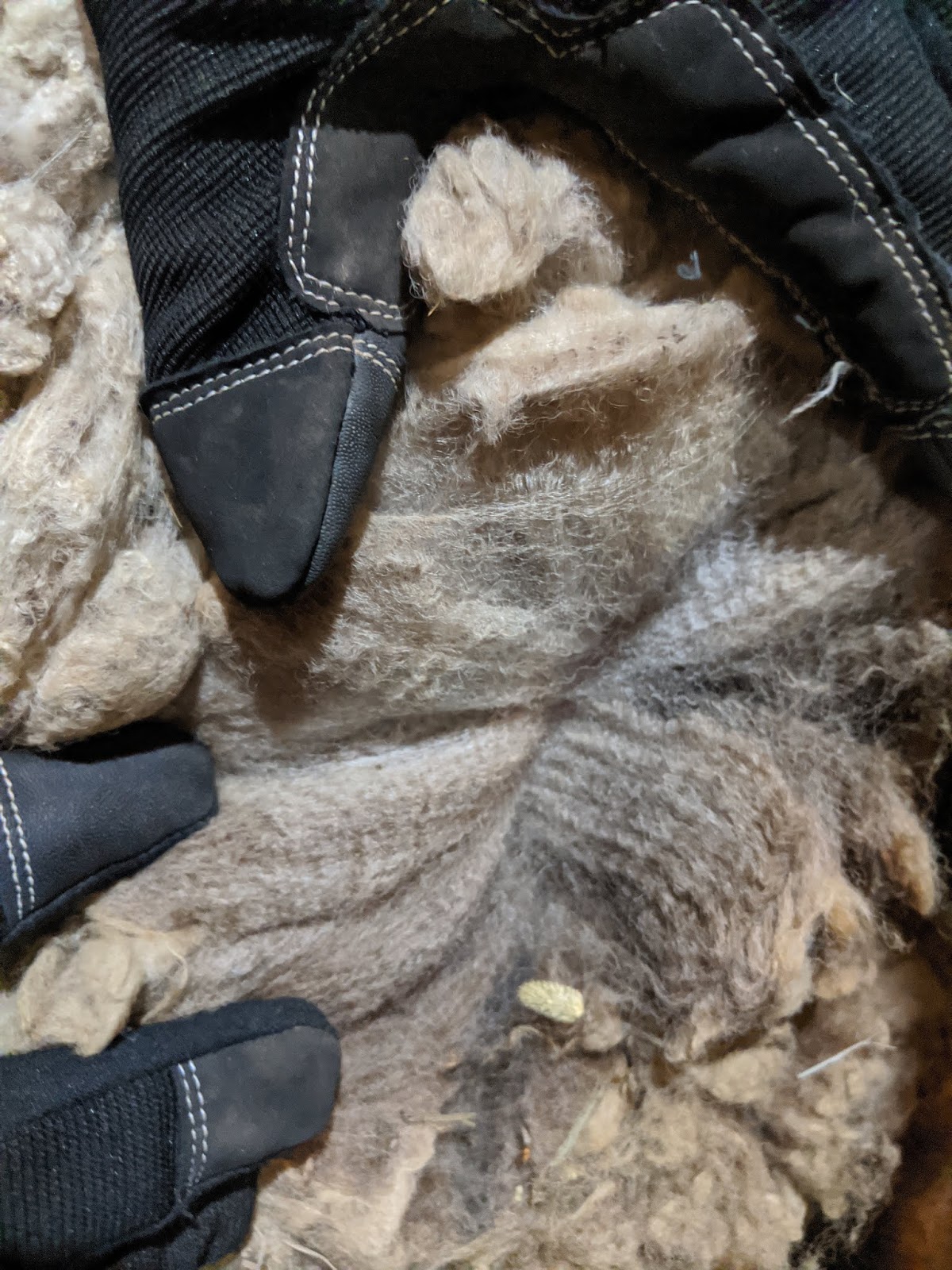
Next is the middle third. I have three different sections photographed here going from front to back (right in front of the hips). The middle third needs to be consistent from the front to back because that is where the micron test was performed and that result needs to apply to the entire thing. When you feel the middle third fleece on most if not all of our sheep, you won’t notice a difference in softness as you move backward.

Middle Front

Middle Front

Middle Middle

Middle Middle

 What you really need to do, however, is part the fleece and evaluate the crimp. Crimp tends to vary based on genetic lines, but there is a high correlation between fineness and crimp. Once you get to know your sheep, you will know whether your fineness holds well just be evaluating the crimp. That’s not to say you can tell how fine the sheep is by looking at the crimp. Crimp is hereditary. I’ve seen finely crimped Shetlands that are coarser (relatively speaking) than another one that has bolder crimp. But when you are in the middle third of each fleece, you shouldn’t see a dramatic change in crimp size as you move to the back. This is what people mean when they say a sheep falls off in the back. Now we are into the back third of the sheep.


You will almost always see a larger crimp structure when you get to this part of the sheep. As I have said previously, however, you should not see a completely different fleece type here. At most, you should see a one grade change when you get to this point compared to the middle third right before it. It should not feel coarse. All of these comments exclude the britch, which admittedly is part of the rear third, but is always skirted out. Finally, we have the britch.


We do not have extreme britch examples to share with you or I would. What you will notice here is that the britch still has crimp and a defined lock structure. It is not hair, in other words. If it was hair, it would have a long tip extending past the main fibers, there would be no crimp, and it would feel coarse. This does not. It is noticeably different than the rest of the fleece, but still very much “Good” Shetland. I am not saying every Shetland should have a fine britch wool. I am saying it doesn’t matter what the britch is like since most people skirt that. I am also saying that the britch has to be limited. If you are in the hip area and have very straight, coarse fiber, you have a fleece that will have to be separated into its various grades and processed accordingly. You are not going to produce next-to-skin yarn from this condition. We tend to skirt pretty heavily in the britch area because it is heavily contaminated with VM, but much of it is very good fiber.  We have started sending our britch wool to the mill to process into yarn.  Before we were at this level of quality the britch wool would just go into the compost pile.

That’s pretty much the nickel tour of fleece variability. I don’t like to see a dramatic loss of crimp in the back third, but it’s not uncommon.

Saturday, November 16, 2019

What I am Working On

Got to spend a little time in the barn with the girls this very cold Saturday morning.


Still flick carding Soraya - about halfway through.


Here is the first plied skein from Soraya, almost iridescent!


Next on the wheel will be the gradient yarn from Cersei


Decided to make batts with the carded locks left from Georgianna, these will be heading to the etsy shop soon.


These yarns are on deck for washing and thwacking today.  L to R we have the Rhinebeck skein, 2 full skeins of Georgianna and 10 small skeins for the sheep heid kits, 10 small skeins of Soraya also for sheep heid and one full skein of Soraya.  They are in the utility tub now for the soapy soak.


Hazel is still on the needles, here I am knitting continental and feeling very sophisticated.  At the airport Monday night waiting to leave for a business trip.


Made a video last weekend to demonstrate my method for flick carding a soft shetland wool fleece:


I need to find a pattern for my millspun yarn ends.  Would like to have a demo of something knit up with my millspun yarns and then feature the pattern.  Something small like a cowl or hat or fingerless mitts.  Any ideas?


Wednesday, June 27, 2007

My Favorite Sheep - Rich

Whispering Pines Buttercup S23372
DOB 4/21/06
Sire: Sheltering Pines Mahogany S20984 (Bucky)
Dam: Whispering Pines Fern S19991
Status: Whispering Pines breeding stock for 2008

Buttercup is a very small (about 48 pounds) yearling ewe born in 2006. She is special to us for several reasons: She was our first smirslet socket lamb born at Whispering Pines, she was also the first one out of one of our own ewes (Fern), and she nearly died during birth.

Fern was also a yearling ewe when she gave birth to Buttercup, but she was very small (less than 40 pounds) and shouldn’t have been bred. During our spring shearing, our shearer cut off one of her teats and we were sort of glad that she didn’t appear to be pregnant (she had no bag and wasn’t showing anything).

One day we were in the barn (fortunately I was off that warm spring day) watching one of our ewes give birth, and after we had just applied the iodine, and were turning to go to the house, we saw Fern starting to have contractions on the other side of the barn. I know it sounds bad that we didn’t know she was pregnant, but she didn’t show anything at all. After about 40 minutes of pushing, we saw one socket front foot and a head, but nothing else. We couldn’t get a vet out there for at least an hour, so I went in and discovered that her right knee was caught on the pelvic bone and I couldn’t quite get my finger behind it.

We were able to get a vet on the phone and she gave me some really bad advice about trying to push the head back in. Fortunately, I quickly determined that wouldn’t work.

Finally, we did get a vet to come out, but the head had been flopping around for more than 30 minutes. After many unsuccessful attempts, and muscle relaxing shots, the vet was able to get the leg and the lamb was born with no problems. Fern was fine as well.

Unfortunately, she didn’t appear to have enough milk. We tried to hand milk her but came up virtually dry. So, from that point on, we supplemented with a bottle.
The vet recommended giving milk at the rate of 10-15% per body weight. In this case, that came out to be about 4 ounces per day with her for the first few days.

Anyway, that’s her story and she probably has the nicest conformation of any of our ewes. She is really extremely nice. We will breed with her this year for the first time. We haven’t decided who will be the lucky ram. Buttercup is out of Sheltering Pines Mahogany.


Myrtle
Registered as Lofty Pine Molly S11881
DOB 3/25/01
Sire: Lofty Pine Greycloud S8347
Dam: Lofty Pine Ellie S4096
Status: Whispering Pines breeding stock for 2008

Myrtle is the old woman in our flock (she’s six). She has a very correct conformation and Jen says she has the nicest fleece (next to Cihat’s, but I digress). I have her listed among my favorites even though I don’t personally like her. Myrtle is the enforcer in the barn, no question about it. She keeps the peace. She is AgAa/BBBB/SSSs. This year’s lambs were her first spotted offerings, but then this is the only the second year we have bred her to a spotted ram (last year she had a solid black ram who was spectacular!). Why is she one of my favorites even though I don't like her personality? Because her lambs are always extremely nice! Here are her lambs from this year:

Whispering Pines Robert E. Lee S24246
DOB 4/9/07
Sire: Twin Springs Brome S23419
Dam: Lofty Pine Molly S11881 (Myrtle)

Status: Available for Sale


Whispering Pines Poppy S24244
DOB 4/9/07
Sire: Twin Springs Brome S23419
Dam: Lofty Pine Molly S11881 (Myrtle)
Status: Sold


Sheltering Pines Cihat S17465
DOB: 4/11/03
Sire: Sheltering Pines Darius S13662
Dam: Wind River Jubilee S2552
Status: Whispering Pines breeding stock for 2008

We got Cihat last fall from Stephen Rouse in Michigan. Stephen has said that Cihat is the last of a line. He is out of Wind River Jubilee and Darius. He is a distant relative of the famous spotted ram S0555 (pictured below). Cihat has a very correct conformation, very soft fleece, great horns, clear markings and a very gentle disposition. He is the nicest ram we’ve ever had and we feel quite fortunate to have him. We only had four lambs out of him this spring, but they were all spectacular (one black, one brown, one white, and one black and white yuglet (pictured below). We will use him on more ewes this fall. I can’t wait to see what we get next year!

S0555 (who we don’t own because he is dead)
he's the one on the right.


Whispering Pines Jeb Stuart S24247
DOB: 4/17/07
Sire: Sheltering Pines Cihat S17465
Dam: Sheltering Pines Black-Eyed Susan S24073
Status: Sold

Jeb’s picture doesn’t do him justice. He is my favorite lamb from this year’s crop. I hated to sell him, but we really don’t have a use for him. He’s virtually a clone of his father. Someone is getting something pretty special, in my opinion.


Whispering Pines Lilly S18755
DOB: 4/15/04
Sire: Whispering Pines Cottonwood S15948
Dam: Lofty Pine Shelia S11880
Status: Whispering Pines Breeding Stock for 2008

Lilly is also home grown. She and Fern were the first sheep our kids took to the Niagara County 4h fair. She has a good conformation, but I was thinking about selling her this year until we installed a wireless CCD camera in the barn this spring. I had no idea what a great mother she is. She would often cuddle with her lamb like a child hugging a stuffed bear. None of our other ewes did that (at least not on camera). Now we can’t sell her. Myrtle, on the other hand, is very aloof and business like about the whole thing.