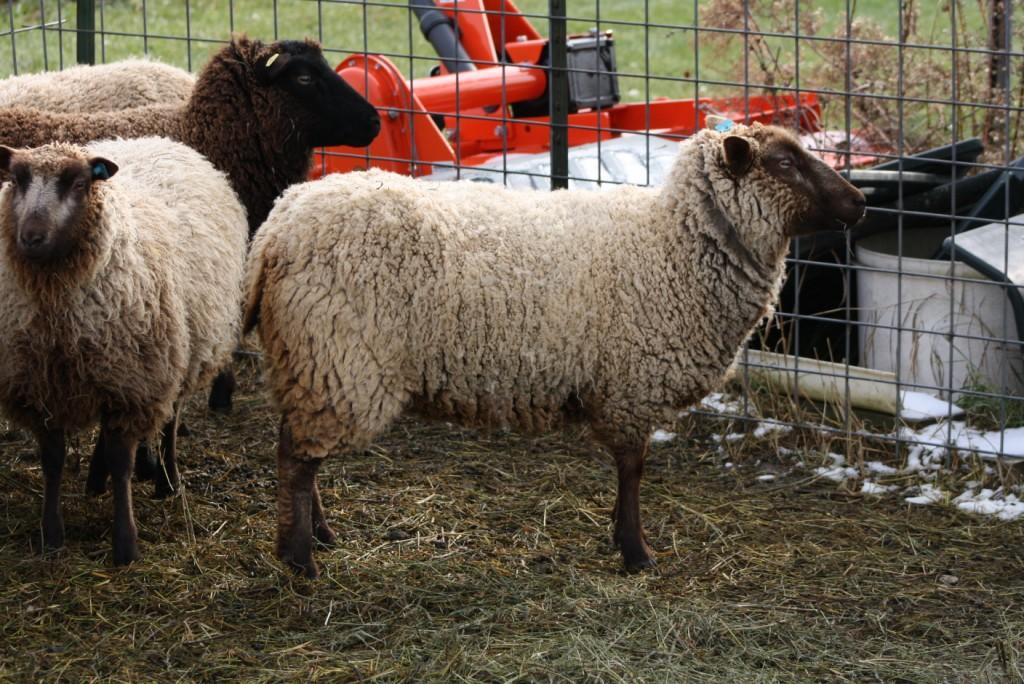
This moorit ewe is out of Wintertime Khan and Sommarang Idelle. I like this lamb for several reasons, one of them being the cool striping on her back legs. Her mother was a fawn katmoget, but almost all white. As a result, I expect this ewe to have some pretty flashy lambs down the road.
This is another lamb who isn't as fine as her parents, but has the bloodline that could potentially pay off down the road. I toyed with the idea of selling her at one point, but had second thoughts. After much debate, I felt her genetics were worth holding onto. She has a nice fleece as well, and we just haven't had a lot of nice moorit fleeces in our flock. Nice tail, straight legs, fine fleece, etc. I feel bad about the ewes that are at the backend of these posts because I have run out of new things to say that I haven't already written.
Wednesday, December 5, 2012
Tuesday, December 4, 2012
Whispering Pines Amaretto
I think I covered all of the adult ewes, so back to the lambs.
This ewe lamb is out of Winter Sky Khan and Whispering Pines Blue Diamond.
As you can see, she resembles her mother in body type. I don't like here fleece as much as her mother's, but it is quite nice. It's a rich dark moorit, which is a must have for any flock. The variety in colors is also very nice, but you almost have to have at least one dark moorit.
I've always felt that it's easier to improve fleeces than conformations, so I think this ewe has a lot of potential. I don't think she is going to be super fine, but both of her parents are. I think that bodes well for her lambs down the road to have such a fine pedigree. Her grandfather is Black Forrest, and her grandmother is Constantinople. Her other grandfather is Wintertime Blues. Her great grandfather is Todhill Jericho. If you follow Shetland bloodlines like I do, that's like being related to Wayne Gretzky, Brett Favre, Peyton Manning, and Mia Hamm. Ultimately, it only matters how good she is, but I'm pretty happy with her quality as well. I think she's one of our better lambs; not the finest, but overall, one of the best this year.
As an aside, I am somewhat surprised at the growth rate of this year's lambs. All were 60 pounds or greater as of November 1st. Given the drought, and the fact that we bred for later lambs than we ever have, I would not have expected that. We have not seen that before. We've been lucky to have one or two that large in the past. I did extend the graining period this year (because of the drought), so it's probably not that much of a mystery is it? We'll no doubt pay for that when we micron fleeces next spring. If the lambs grew that well, and the adults are all well-conditioned, you know the fleeces are going to micron higher as well, right? Still trying to find the right balance with all of the variables.
For comparison, our average lamb weights in the past were somewhere between 45 and 50 pounds in about the same timeframe (about six months). I did an experiment many years ago where I took twins and grained one, but not the other, and that difference in weight was pretty dramatic with the same grain and rations that I used this year (about 1/2 cup per sheep). It doesn't seem like much, but it clearly impacts growth. I did the same thing last fall with the adults in an attempt at increasing the twinning rate, and it accomplished the opposite. All of the ewes seemed in good condition, but we still had a lot of singles (even out of the ewes that normally twin). On the flip side, we did have a lot of ewe lambs, so that made up for it.
This ewe lamb is out of Winter Sky Khan and Whispering Pines Blue Diamond.
As you can see, she resembles her mother in body type. I don't like here fleece as much as her mother's, but it is quite nice. It's a rich dark moorit, which is a must have for any flock. The variety in colors is also very nice, but you almost have to have at least one dark moorit.
I've always felt that it's easier to improve fleeces than conformations, so I think this ewe has a lot of potential. I don't think she is going to be super fine, but both of her parents are. I think that bodes well for her lambs down the road to have such a fine pedigree. Her grandfather is Black Forrest, and her grandmother is Constantinople. Her other grandfather is Wintertime Blues. Her great grandfather is Todhill Jericho. If you follow Shetland bloodlines like I do, that's like being related to Wayne Gretzky, Brett Favre, Peyton Manning, and Mia Hamm. Ultimately, it only matters how good she is, but I'm pretty happy with her quality as well. I think she's one of our better lambs; not the finest, but overall, one of the best this year.
As an aside, I am somewhat surprised at the growth rate of this year's lambs. All were 60 pounds or greater as of November 1st. Given the drought, and the fact that we bred for later lambs than we ever have, I would not have expected that. We have not seen that before. We've been lucky to have one or two that large in the past. I did extend the graining period this year (because of the drought), so it's probably not that much of a mystery is it? We'll no doubt pay for that when we micron fleeces next spring. If the lambs grew that well, and the adults are all well-conditioned, you know the fleeces are going to micron higher as well, right? Still trying to find the right balance with all of the variables.
For comparison, our average lamb weights in the past were somewhere between 45 and 50 pounds in about the same timeframe (about six months). I did an experiment many years ago where I took twins and grained one, but not the other, and that difference in weight was pretty dramatic with the same grain and rations that I used this year (about 1/2 cup per sheep). It doesn't seem like much, but it clearly impacts growth. I did the same thing last fall with the adults in an attempt at increasing the twinning rate, and it accomplished the opposite. All of the ewes seemed in good condition, but we still had a lot of singles (even out of the ewes that normally twin). On the flip side, we did have a lot of ewe lambs, so that made up for it.
Monday, December 3, 2012
Whispering Pines Kiyah
This Egyptian King daughter out of Blue Diamond built
very well, and ranks high in our rating system for Shetlands.
Kiyah has a very fine and dense fleece with the type of crimp that we like so well. I don’t care for the larger crimp and don’t breed for that. There’s nothing wrong with larger crimp at all, but the smaller crimp give you the ability to build elasticity into your products. Over time, I would expect to have our flock fairly evenly split in terms of crimp style as long as they are all fine or super fine. Overall, this is probably one of our nicest ewes and we’ve been waiting to see what our Egyptian King offspring will produce. It’s another great bloodline that goes back to Wintertime Bond, Todhill Jericho, and Sheltering Pines Salicional. That’s about as good as it gets for bloodlines in a Shetland.
I think Kiyah is a pretty good example of the type of improvement that is possible with the breed. Constantinople is a little taller than we like (not excessively tall, but on a relative scale), and Egyptian King is on the stocky side. I actually like his build, because he has a wider stance than some of our other rams, and he is also smaller. Plus, he added some of those traits in his lamb. Plus, he has a gorgeous head. Now that I am saying all of this, I'm wondering why I've never bred him to Constantinople. Hmmm...anyway, I bred her daughter, Blue Diamond, to him, and I liked the results. Maybe next year. My point was, that in two generations, we have a ewe with a lot of the traits that Constantinople has (length of body, proportions), and added his fleece (dense, uniform, crimpy, and fine). I actually like Blue Diamond's fleece better, because it has better overall type, but I don't think I've ever seen (and I know we've never had) a Shetland with a CRV of 107.1. I checked past micron results, and even Bond wasn't that crimpy. His CRV was 84.7, which I thought was pretty incredible at the time.
Having said all of that, there are things I want to improve with this ewe, so we'll have to see how that goes. I always say that balance is what we are after, and super fine is desirable, but so is crimp, luster, length, and lock structure. For comparision purposes, Genoa (in my opinion), has a nicer fleece than Kiyah, but her CRV is only 77.0. And yet, Genoa is a micron finer than Kiyah at the same age. What I have concluded from all of that is that I prefer my yearlings to be in the 21-24 micron range because those have been our nicest fleeces. We have also had some really nice yearling fleeces higher than that, however. It seems like 22-23 microns is the sweetspot in terms of balance. Of course, all of that depends on what you like in your fleeces, I suppose.
Also, the ewe lamb behind Kiyah is Constantinople's from this year. You have a granddaughter and daughter in the same picture. They have very different fleeces, but they share her topline and other characteristics that I like (as shown below). Also, both ewes have less britch than Constantinople has (although she doesn't really have that much in the whole scheme of things, just a little more than most of our sheep). What that equates to is higher yield (which is why we are able to charge so much for our fleeces).
Behind Constantinople are Blue Diamond (her daughter from two years ago), and Irish Rose (her daughter from last year). Yes, we probably have two many Constantinople offspring, but I like them, what can I say?
Kiyah has a very fine and dense fleece with the type of crimp that we like so well. I don’t care for the larger crimp and don’t breed for that. There’s nothing wrong with larger crimp at all, but the smaller crimp give you the ability to build elasticity into your products. Over time, I would expect to have our flock fairly evenly split in terms of crimp style as long as they are all fine or super fine. Overall, this is probably one of our nicest ewes and we’ve been waiting to see what our Egyptian King offspring will produce. It’s another great bloodline that goes back to Wintertime Bond, Todhill Jericho, and Sheltering Pines Salicional. That’s about as good as it gets for bloodlines in a Shetland.
I think Kiyah is a pretty good example of the type of improvement that is possible with the breed. Constantinople is a little taller than we like (not excessively tall, but on a relative scale), and Egyptian King is on the stocky side. I actually like his build, because he has a wider stance than some of our other rams, and he is also smaller. Plus, he added some of those traits in his lamb. Plus, he has a gorgeous head. Now that I am saying all of this, I'm wondering why I've never bred him to Constantinople. Hmmm...anyway, I bred her daughter, Blue Diamond, to him, and I liked the results. Maybe next year. My point was, that in two generations, we have a ewe with a lot of the traits that Constantinople has (length of body, proportions), and added his fleece (dense, uniform, crimpy, and fine). I actually like Blue Diamond's fleece better, because it has better overall type, but I don't think I've ever seen (and I know we've never had) a Shetland with a CRV of 107.1. I checked past micron results, and even Bond wasn't that crimpy. His CRV was 84.7, which I thought was pretty incredible at the time.
Having said all of that, there are things I want to improve with this ewe, so we'll have to see how that goes. I always say that balance is what we are after, and super fine is desirable, but so is crimp, luster, length, and lock structure. For comparision purposes, Genoa (in my opinion), has a nicer fleece than Kiyah, but her CRV is only 77.0. And yet, Genoa is a micron finer than Kiyah at the same age. What I have concluded from all of that is that I prefer my yearlings to be in the 21-24 micron range because those have been our nicest fleeces. We have also had some really nice yearling fleeces higher than that, however. It seems like 22-23 microns is the sweetspot in terms of balance. Of course, all of that depends on what you like in your fleeces, I suppose.
Also, the ewe lamb behind Kiyah is Constantinople's from this year. You have a granddaughter and daughter in the same picture. They have very different fleeces, but they share her topline and other characteristics that I like (as shown below). Also, both ewes have less britch than Constantinople has (although she doesn't really have that much in the whole scheme of things, just a little more than most of our sheep). What that equates to is higher yield (which is why we are able to charge so much for our fleeces).
Behind Constantinople are Blue Diamond (her daughter from two years ago), and Irish Rose (her daughter from last year). Yes, we probably have two many Constantinople offspring, but I like them, what can I say?
Saturday, December 1, 2012
Sommarang Ilke
Okay, I got out this morning and got some more pictures, so let's go back to our adults again and take a quick break from the lambs.
Sommarang Ilke is another ewe that we brought in last year
and she is Isla’s half-sister (same father - Avyt). She is smaller than Isla, but I
like her fleece even better. Her yearling micron test was nearly identical to
Isla’s, but I definitely like her fleece better.
How fine is she? Her yearling micron test had an avg fiber diameter of 22.3. I'm not sure how much it will increase this year, but it still feels super fine to me. Her CEM is 9.7, which is higher than I prefer, but indicative of a single coated fleece, nontheless. Her CV is 22%, which is also higher than I like, but still in the range that I find acceptable. Her CRV is 72.2, which is also very good. The CRV is a measure of the amount of crimp present. We have smaller and tighter crimp than this in our flock, but this is still an excellent number. Compare that number to Kiyah for contrast. Kiyah is off the charts.
It’s nice having moorits in
the flock again, but it’s especially gratifying to have Shetlands like this.
They aren’t a dime a dozen; trust me on that.
Thursday, November 29, 2012
Whispering Pines Irish Mist
Well, since this lamb looks nearly identical to her sister Frangelico, I decided to post both consecutively.
There isn't much to add that I didn't already say about Frangelico, except that this one is spotted. Other than that, the differences are small.
The fleece pictures might look at little different, but they weren't taken in the same spot. Frangelico's was taken mid-rib, while this one taken half-way back, but higher up. I just wanted to show how it varies some, but not a great deal.
There isn't much to add that I didn't already say about Frangelico, except that this one is spotted. Other than that, the differences are small.
The fleece pictures might look at little different, but they weren't taken in the same spot. Frangelico's was taken mid-rib, while this one taken half-way back, but higher up. I just wanted to show how it varies some, but not a great deal.
Whispering Pines Frangelico
This is fawn katmoget ewe is a good example of Constantinople's get. She is out of Wintertime Khan. She has oodles of Shetland type, with a very fine, soft fleece. Great luster, density, and good length without tip. We've had finer lambs, but none any nicer. I like her.
I've noticed that we are rapidly accumulating Constantinople's genetics here, which isn't a bad thing, but all her ewes have had excellent conformations, fleeces, and overall type. I'm still looking for a ram from her possessing her head and overall structure, but until we get that, we're enjoying ewe lambs like this one. I also like that this lamb has a different fleece type than some of the other ewes in our flock. We really don't want all of one type. What we are really interested in getting out of Constantinople are lambs that hold their fineness well into adulthood like she has. She was never super fine, but her fleece micron has held rock steady over the years. That's one of those things that you can only find out with time. So far, Blue Diamond has held steady as well, but we'll need more data points on both her and the other Constantinople lambs.
Tuesday, November 27, 2012
Whispering Pines Coloma
Well, I have a few more adult ewes to blog about, but I lack good pictures, so they'll have to wait. So, on to the lambs.
This is Whispering Pines Coloma out of Wintertime Itasca and Winter Sky Khan. I have blabbed on enough about Itasca's attributes, but I haven't shared anything on Khan. Khan is a very fine, moorit ram out of Black Forrest. His two year old micron test was 22.5 with a low CV. When I say low, I usually mean around 20%. I often don't share all of the micron statistics, because a lot of people either don't care to read about math or don't understand what all of the numbers mean. I've written several articles on the importance of micron data on fiber animals, and I'll no doubt do that again on this blog at some point, but for now, trust me when I say he is super fine (which is a relative term used by some of us Shetland folk).
Sorry, no fleece pictures on the lambs. I just haven't had time.
Oh, I was supposed to be talking about the lamb wasn't I? Itasca has produced some nice ewes, and I like this one as well. She isn't going to be super fine like her parents, but she has a nice fleece that is very uniform with nice density. Overall, I think she is a keeper. It'll be hard to hold onto all of these lambs come next spring because I like all of the adults a great deal, and I expect nice lambs next year as well. We ran into that problem this year as well, and ended up selling ewes that I probably should've kept. Next year, I might not be so quick to pull the trigger on ewe sales. Still, I'll probably have to come up with 10-12 to keep our size manageable.
Plus, I'd really like to keep some high quality moorits if at all possible. Overall, I'd probably rank this lamb at or near the top of this year's lamb crop, however, which means I'll work hard to try and keep her. Given the bloodlines, I'd be surprised if the majority of these ewe lambs don't end up producing lambs that are finer than they are.
This is Whispering Pines Coloma out of Wintertime Itasca and Winter Sky Khan. I have blabbed on enough about Itasca's attributes, but I haven't shared anything on Khan. Khan is a very fine, moorit ram out of Black Forrest. His two year old micron test was 22.5 with a low CV. When I say low, I usually mean around 20%. I often don't share all of the micron statistics, because a lot of people either don't care to read about math or don't understand what all of the numbers mean. I've written several articles on the importance of micron data on fiber animals, and I'll no doubt do that again on this blog at some point, but for now, trust me when I say he is super fine (which is a relative term used by some of us Shetland folk).
Sorry, no fleece pictures on the lambs. I just haven't had time.
Oh, I was supposed to be talking about the lamb wasn't I? Itasca has produced some nice ewes, and I like this one as well. She isn't going to be super fine like her parents, but she has a nice fleece that is very uniform with nice density. Overall, I think she is a keeper. It'll be hard to hold onto all of these lambs come next spring because I like all of the adults a great deal, and I expect nice lambs next year as well. We ran into that problem this year as well, and ended up selling ewes that I probably should've kept. Next year, I might not be so quick to pull the trigger on ewe sales. Still, I'll probably have to come up with 10-12 to keep our size manageable.
Plus, I'd really like to keep some high quality moorits if at all possible. Overall, I'd probably rank this lamb at or near the top of this year's lamb crop, however, which means I'll work hard to try and keep her. Given the bloodlines, I'd be surprised if the majority of these ewe lambs don't end up producing lambs that are finer than they are.
Subscribe to:
Posts (Atom)