I have some more thoughts on this past weekend’s WSWF in lovely Wisconsin.
I don’t know that anyone walked away from the event thinking that there is only one correct Shetland. I think that’s been a fear for a lot of people when we start comparing the SSS sheep to what we have here in the US. On the contrary, I saw an incredible amount of diversity at Jefferson. I think that’s what we want in NASSA. And Kate and Alan were very open about that fact. You have to emphasize correct breed type (which they did), but you also have to recognize that there is a range of acceptable traits to consider. I hope we all came away with that lesson.
I have also heard it said that fine fleece people are single trait breeders; just focusing on fineness at the expense of other perhaps more valuable traits. Well, I can tell you that I didn’t see evidence of that in Jefferson. I saw correct conformations and fine fleeces in most cases. And it doesn’t matter what I think about it, Kate and Alan saw the same thing (and noted it). No, they didn’t pass everything put before them, but they were very good at pointing out the strengths and weaknesses so that improvement was within reach.
Alan made a good point during the wool show. Someone asked what makes one fleece long and straight and another 4” and crimpy? Was it nutrition? And he was rather pointed with his response, saying it was because of selection. Specifically, proper breeding and proper selection. That may seem obvious to some, but clearly that’s not universally understood. That’s the kind of thing that made Jefferson so special. Having a candid exchange of ideas, and being receptive to the incredible experience that we were provided. We could all agree or disagree with what Kate and Alan chose in the ring, but I don’t think that was the point. If you don’t consider other views and open yourself up to new ideas, there can be no learning.
As time passes, we’ll all drift off doing our own things with our flocks, but we can’t lose the lessons we learned this past weekend, which is that we can have wonderful diversity and not give up correct Shetland traits. But we have to be willing to be open-minded about learning, and not stubbornly stick to our preconceived notions about the breed. I know our flock will be better in the future because of what I learned over the weekend. And I can be as stubborn as anyone.

Superior Genetics and Fine Fleeces for the discriminating handspinner
Friday, September 16, 2011


Monday, September 12, 2011
Jefferson
I got back from The Wisconsin Sheep and Wool Festival on Sunday and I have to say it was a pretty special event. I had an opportunity to spend a lot of time over the weekend with Kate Sharp and Alan Hill talking a great deal about Shetland history and learning a ton about the breed. As many of you know, we have spent the last few years really working hard at bringing our flock up to snuff with the 1927 Shetland Breed standard. It’s important to me to have our flock in close alignment with what the 1927 standard requires. And spending three days with actual certified Shetland Sheep Society inspectors and judges was incredibly valuable. Just what the doctor ordered.
The highlight for me was participating in the inspector and judge’s training on Friday. You don’t know what you don’t know until you spend time working side-by-side with two absolute masters like Kate and Alan. The methodical “hands on” approach was something to watch. I’ll never forget it. It was nice receiving some confirmation that our breeding approach isn’t all that far off, but the real value for me was in getting additional clarification around the finer points of the breed standard.
I had a little apprehension about hearing what they had to say because it was entirely possible that my understanding of Shetland sheep was way off. I was relieved to find out that it isn’t, but the whole thing was incredibly educational. I know I will take the lessons to heart (as I’m sure the other participants in the training will).
The morning portion of the training involved Kate and Alan demonstrating the finer points of inspection on a live animal (one of Garrett’s rams. I don’t know which one, but he was nice).
This was followed with a discussion around judging in the UK, which was quite informative.
The afternoon session involved breaking up into two groups to have the judges evaluate individual animals. That was an incredible learning experience because all of the sheep were different. It was interesting to see how they approached assessing the diversity. I also have to confess that I was moving back and forth between groups so I could see how each judge was handling each point in the standard. It was probably as good as or better than any training I have received on any subject.
On Saturday, I had a lot of fun watching the fleece competition, which was also judged by Kate and Alan. The top two prizes went to fleeces by Karen Valley and her daughter Meghan. Third place went to one of Garrett’s fleeces. I think Karen or Meghan also got fourth with another fleece. I might be mistaken about that. Theresa Gygi took fifth place honors with one of her black fleeces. Keep in mind that this was a huge Shetland fleece class. Alan and Kate told me in private that all the fleeces in the top 10 would’ve been indistinguishable from the top fleeces in a UK show! That’s pretty impressive. Theresa’s daughter Tori also took first place in the white Shetland class. That was also a large class. Congrats to everyone.
Finally, the show was pretty awesome on Saturday afternoon. Below are some pictures.
Lori Stephenson took top honors with Firth of Fifth Avyt in the ram class. Let me just say that he was an incredible Shetland ram. Her ram Hacket was also incredible as was Karen’s ram Grasshopper. I was amazed at the quality of the sheep at this show.
In the ewe class, Kelly Bartels took first place overall with Sheltering Pines Salicional (Constantinople’s mother). As I was watching the class, I commented to someone that the ewes in that class were unbelievable! You had lambs, yearlings, and adults in one class, and each one was absolutely spectacular! Each was a champion and I know Kelly is extremely happy with having Salicional pull out top honors! That says something about how good she is.
I could go on and on, but it was a great time, and I don’t know if I’ve ever seen such a great collection of Shetlands in one place before. I would’ve liked to have taken some of our sheep, but I didn’t feel comfortable dragging them that far. Kudos to the people who did!
I don’t have a lot of pictures (an annoying story), but here are a few.

This is Theresa’s ewe lamb. I don’t know her name, but she was extremely nice.

This moorit ewe was Lori Stephenson’s. She was standing right by me, so I got a pretty good picture of her. I think she’s a good example of the type of sheep that were in that large ewe lamb class. I think there were 37 ewes in that class. Karen Valley's beautiful black ewe is next to Lori's.

Here is another of Lori’s ewes. Lori had several good ones. I didn’t get good pictures of a lot of the other lambs in that class, but I have a few more I’ll post in the coming days. Lori did take first and second place in the best pair of ewe lambs class.
The whole thing was a lot of fun and hopefully this gives you an idea of the quality of Shetlands there.
The highlight for me was participating in the inspector and judge’s training on Friday. You don’t know what you don’t know until you spend time working side-by-side with two absolute masters like Kate and Alan. The methodical “hands on” approach was something to watch. I’ll never forget it. It was nice receiving some confirmation that our breeding approach isn’t all that far off, but the real value for me was in getting additional clarification around the finer points of the breed standard.
I had a little apprehension about hearing what they had to say because it was entirely possible that my understanding of Shetland sheep was way off. I was relieved to find out that it isn’t, but the whole thing was incredibly educational. I know I will take the lessons to heart (as I’m sure the other participants in the training will).
The morning portion of the training involved Kate and Alan demonstrating the finer points of inspection on a live animal (one of Garrett’s rams. I don’t know which one, but he was nice).
This was followed with a discussion around judging in the UK, which was quite informative.
The afternoon session involved breaking up into two groups to have the judges evaluate individual animals. That was an incredible learning experience because all of the sheep were different. It was interesting to see how they approached assessing the diversity. I also have to confess that I was moving back and forth between groups so I could see how each judge was handling each point in the standard. It was probably as good as or better than any training I have received on any subject.
On Saturday, I had a lot of fun watching the fleece competition, which was also judged by Kate and Alan. The top two prizes went to fleeces by Karen Valley and her daughter Meghan. Third place went to one of Garrett’s fleeces. I think Karen or Meghan also got fourth with another fleece. I might be mistaken about that. Theresa Gygi took fifth place honors with one of her black fleeces. Keep in mind that this was a huge Shetland fleece class. Alan and Kate told me in private that all the fleeces in the top 10 would’ve been indistinguishable from the top fleeces in a UK show! That’s pretty impressive. Theresa’s daughter Tori also took first place in the white Shetland class. That was also a large class. Congrats to everyone.
Finally, the show was pretty awesome on Saturday afternoon. Below are some pictures.
Lori Stephenson took top honors with Firth of Fifth Avyt in the ram class. Let me just say that he was an incredible Shetland ram. Her ram Hacket was also incredible as was Karen’s ram Grasshopper. I was amazed at the quality of the sheep at this show.
In the ewe class, Kelly Bartels took first place overall with Sheltering Pines Salicional (Constantinople’s mother). As I was watching the class, I commented to someone that the ewes in that class were unbelievable! You had lambs, yearlings, and adults in one class, and each one was absolutely spectacular! Each was a champion and I know Kelly is extremely happy with having Salicional pull out top honors! That says something about how good she is.
I could go on and on, but it was a great time, and I don’t know if I’ve ever seen such a great collection of Shetlands in one place before. I would’ve liked to have taken some of our sheep, but I didn’t feel comfortable dragging them that far. Kudos to the people who did!
I don’t have a lot of pictures (an annoying story), but here are a few.

This is Theresa’s ewe lamb. I don’t know her name, but she was extremely nice.

This moorit ewe was Lori Stephenson’s. She was standing right by me, so I got a pretty good picture of her. I think she’s a good example of the type of sheep that were in that large ewe lamb class. I think there were 37 ewes in that class. Karen Valley's beautiful black ewe is next to Lori's.

Here is another of Lori’s ewes. Lori had several good ones. I didn’t get good pictures of a lot of the other lambs in that class, but I have a few more I’ll post in the coming days. Lori did take first and second place in the best pair of ewe lambs class.
The whole thing was a lot of fun and hopefully this gives you an idea of the quality of Shetlands there.
Thursday, August 18, 2011
Egyptian King Lamb Fleeces
I’ve already said how much we like the Egyptian King lambs, but pictures are always worth more than a thousand words.
This shaela ram out of Sheltering Pines Christmas Holly is a good example of what we like in a Shetland. He is very much like Holly’s ram from last year, Rowdy. I think he’s a great example of a polled Shetland ram. He didn’t do me any favors by taking a nice roll in the grass clippings for this photo shoot, but it at least gives you an idea of his qualities.


I think he will micron in the 24-to-25 range as a yearling, based on what I see right now. More importantly, he has good lock structure, consistency, and will have a low CV, which translates directly to the handle of the fleece.
Blue Diamond is a Blue’s Clues daughter from last spring who we like a great deal. Her black daughter is quite impressive. Great lock structure, uniformity, density, and fineness. She will probably micron in the 23—24 range with a low CV. This is an excellent black ewe who carries spots and moorit. She’s better than her mother, which is what we are all about.
Unfortunately, I thought I had a current picture, but did not. I'll have to get one this weekend.


Her sister is a fawn katmoget, who quite frankly, is nicer than her sister. This ewe is our finest of the year, in my opinion, and I don’t feel that she trades off much for that fineness. How fine will she be? Who can say? I would guess 21 microns with a low CV.
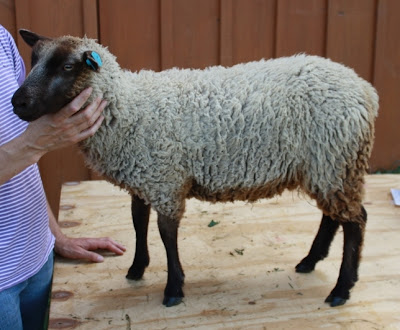

Blue Sapphire was one of our favorite ewes last year. She is a Blue’s Clues daughter who had a fleece that was the most like his. I’ll probably never have another fleece like his, but it’ll be fun trying. So, when we bred her to Egyptian King, we had high hopes for the lamb. And we weren’t disappointed. This ram lamb is nicer than both parents, in my opinion. He is scurred (yes, those are scurs. I’m not going to try to convince anyone that he’s polled), but they are small scurs, which is a good thing.


Anyway, he’s very fine, has great density, and an awesome conformation. We’ll just have to see how he matures. I think he will be close to 22 microns as a yearling, and probably a really low CV (maybe 16%). Just a great ram out of fantastic genetics!
Did I say that I like Egyptian King? I’ll do a post on him at some point.
This shaela ram out of Sheltering Pines Christmas Holly is a good example of what we like in a Shetland. He is very much like Holly’s ram from last year, Rowdy. I think he’s a great example of a polled Shetland ram. He didn’t do me any favors by taking a nice roll in the grass clippings for this photo shoot, but it at least gives you an idea of his qualities.


I think he will micron in the 24-to-25 range as a yearling, based on what I see right now. More importantly, he has good lock structure, consistency, and will have a low CV, which translates directly to the handle of the fleece.
Blue Diamond is a Blue’s Clues daughter from last spring who we like a great deal. Her black daughter is quite impressive. Great lock structure, uniformity, density, and fineness. She will probably micron in the 23—24 range with a low CV. This is an excellent black ewe who carries spots and moorit. She’s better than her mother, which is what we are all about.
Unfortunately, I thought I had a current picture, but did not. I'll have to get one this weekend.


Her sister is a fawn katmoget, who quite frankly, is nicer than her sister. This ewe is our finest of the year, in my opinion, and I don’t feel that she trades off much for that fineness. How fine will she be? Who can say? I would guess 21 microns with a low CV.


Blue Sapphire was one of our favorite ewes last year. She is a Blue’s Clues daughter who had a fleece that was the most like his. I’ll probably never have another fleece like his, but it’ll be fun trying. So, when we bred her to Egyptian King, we had high hopes for the lamb. And we weren’t disappointed. This ram lamb is nicer than both parents, in my opinion. He is scurred (yes, those are scurs. I’m not going to try to convince anyone that he’s polled), but they are small scurs, which is a good thing.


Anyway, he’s very fine, has great density, and an awesome conformation. We’ll just have to see how he matures. I think he will be close to 22 microns as a yearling, and probably a really low CV (maybe 16%). Just a great ram out of fantastic genetics!
Did I say that I like Egyptian King? I’ll do a post on him at some point.
Tuesday, August 16, 2011
Lamb and Fleece Evaluations
I wanted to share some of my assessments of this year’s lambs before time gets completely away from me. We did the final round of CDT shots on Saturday, and that gave us a chance to evaluate each of them more closely.
I decided to break them down by sire, which seemed as good of an approach as any.
First, the Little Buckeroo lambs.
This one is easy since we only have two ewes left and both are out of Itasca. These lambs are F2 Jerichos, who is one of my favorite UK rams.
The first one is Itasca’s fawn ewe. I really like this ewe. She has an excellent conformation, nice fleece length, and luster up the ying yang. She has a bolder crimp, which really shows off the luster. I don’t know if others have noticed this, but the larger crimp seems to really reveal the full amount of luster. The tightly crimped lambs don’t seem to do that. I suppose if I stretched them out and compared side-by-side, I’d see it, but the fingers really glide over this fleece. I think it’s a bit early to predict micron values, but I think this one will be 26 microns as a yearling. It’s probably close to that now and might possibly increase by one or so by next spring. Who knows?


Her sister is a grey katmoget with a different style of fleece. It should be around 3.5 inches next spring, but it will definitely be finer than her sister’s. I would say between 22 and 23 microns. It’s just a beautiful fleece on an outstanding ewe lamb!


That’s it for the F2 Jericho ewes.
We still have one ram left from Buckeroo and I will do my usual lamenting on how I wish he was a ewe. Actually, I don’t. I wish he was polled. It’s a fleece that we really like. I think it’ll be 4.5 inches and fine! And I don’t see much tip either, so the CV should be pretty darn low as well. It’s just very soft with tons of potential. But, he’ll be wethered. There’s nothing wrong with a good fiber animal – the gift that keeps on giving. I just wish we could’ve used him in our program.
He is out of Irish Lace.


I decided to break them down by sire, which seemed as good of an approach as any.
First, the Little Buckeroo lambs.
This one is easy since we only have two ewes left and both are out of Itasca. These lambs are F2 Jerichos, who is one of my favorite UK rams.
The first one is Itasca’s fawn ewe. I really like this ewe. She has an excellent conformation, nice fleece length, and luster up the ying yang. She has a bolder crimp, which really shows off the luster. I don’t know if others have noticed this, but the larger crimp seems to really reveal the full amount of luster. The tightly crimped lambs don’t seem to do that. I suppose if I stretched them out and compared side-by-side, I’d see it, but the fingers really glide over this fleece. I think it’s a bit early to predict micron values, but I think this one will be 26 microns as a yearling. It’s probably close to that now and might possibly increase by one or so by next spring. Who knows?


Her sister is a grey katmoget with a different style of fleece. It should be around 3.5 inches next spring, but it will definitely be finer than her sister’s. I would say between 22 and 23 microns. It’s just a beautiful fleece on an outstanding ewe lamb!


That’s it for the F2 Jericho ewes.
We still have one ram left from Buckeroo and I will do my usual lamenting on how I wish he was a ewe. Actually, I don’t. I wish he was polled. It’s a fleece that we really like. I think it’ll be 4.5 inches and fine! And I don’t see much tip either, so the CV should be pretty darn low as well. It’s just very soft with tons of potential. But, he’ll be wethered. There’s nothing wrong with a good fiber animal – the gift that keeps on giving. I just wish we could’ve used him in our program.
He is out of Irish Lace.


Sunday, August 7, 2011
Lamb Colors
It’s been a while since I’ve posted anything on our blog, so I thought I’d share some pictures of lambs that I still like. I can’t say for sure they will all be keepers (we are only keeping the 10 ewe lambs that we think best meet our requirements), but I like them for different reasons.
First are Itasca’s katmoget lambs out of Little Buckeroo. These lambs are 61% UK. I like the grey better than the fawn, but these lambs are a good example of the diversity you can get out of Shetlands. Both should be fine, but the fawn will have a longer fleece (maybe 5 inches) than the grey. I’ll post more current pictures once we get more time. As you look at the pictures, notice the differences in colors and markings, even though all of these lambs are katmogets.


The next lamb is Peridot’s out of Pompey. Just a tremendous grey katmoget ewe lamb with great genetics behind her. It was my first attempt at line breeding around Pompey. I took a Bond daughter and bred her to Pompey, who is her great grandfather. I just love the katmogets – especially this line. This lamb will be very fine; perhaps our finest. We are trying to breed for fine fleeces without losing some of the more valuable fleece traits such as silkiness, crimp, and lock structure. I would say this lamb looks similar to Itasca’s grey, but not quite. This lamb is only 43% UK, but I think you can see the influence of those genetics, and she would look very much at home in a UK Flock book flock. For those readers not familiar with what a Flock Book flock is, it’s an organization in the UK that inspects Shetlands to the 1927 standard (in fact, they wrote the standard). Only the best of the best qualify. I’m not saying this lamb would qualify, but UK folks would recognize her as a Shetland that meets most of the 1927 standard’s requirements. Oh, and yes, the Shetlands that were imported to North America in 1980 were from Flock Book flocks.
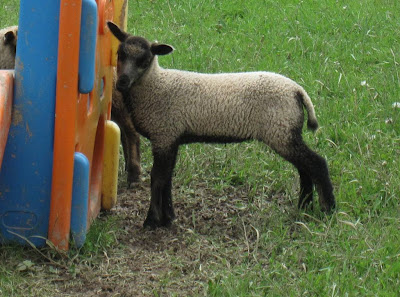
At birth, I thought Cor de Nuit’s ewe lamb was our best of the year, and I still think that way. She has a nice frame without possessing too much bone. Shetlands are supposed to be fine boned. But her overall conformation and fleece are pretty close to the total package. She is out of Pompey, and 43% UK. Again, not a huge percentage, but she looks quite a bit different than other Shetlands that you might see. She will also be fine, but perhaps not as fine as Peridot’s ewe. That’s what my evaluation is telling me. I’m not going to guess at the micron level for another month or so. I know what I think, but I’ll wait. This is one of those lambs that would’ve received a rather large breeding group had she been a ram. I’ve been looking for a ewe out of Cor de Nuit and now that she’s had one, I’m wishing it was a ram. I loathe myself sometimes. I like this lamb better than her half brother, Egyptian King.

The last lamb to share is Shiobhan’s grey katmoget. This lamb is pretty impressive as well. I would argue that she’s the prettiest lamb we’ve had here. This picture does a decent job of illustrating the markings and colors. She’s probably the darkest katmoget we’ve had here as well. Her fleece? Very yummy. As I said, we’ll post more pictures soon (just got back from vacation and are way behind on things). This lamb is 58% UK.


The point of this post is to illustrate how different the markings and colors can be with this breed. I like the darker colors (particularly the katmogets), but our breeding program revolves around quality, not color and markings. If the fleeces are exceptional (as all of these are), I don’t care about color and markings that much. Of course, that thought process gave us a flock that is predominately katmoget.
I’ve noticed that the road less travelled is a tough path to follow. It’s hard to breed for sheep of this quality, and it’s hard to sell grey katmogets. People seem to like spots. Heck, I Iike spots. I wish it was easy to produce spotted Shetlands with fleeces like these. I wish it were easy to find quality non-katmoget rams. Fortunately, we have one in Egyptian King, but we don’t have one in moorit. So, it’s tough. And it’s tempting to bite at the hook that a lot of customers seem to be putting in front of us. But, I unless we produce what I consider to be a quality Shetland, I don’t think we are doing anything for the breed. As a result, we’ll continue on this path and hopefully produce more variety of colors and markings along with stunning fleeces.
First are Itasca’s katmoget lambs out of Little Buckeroo. These lambs are 61% UK. I like the grey better than the fawn, but these lambs are a good example of the diversity you can get out of Shetlands. Both should be fine, but the fawn will have a longer fleece (maybe 5 inches) than the grey. I’ll post more current pictures once we get more time. As you look at the pictures, notice the differences in colors and markings, even though all of these lambs are katmogets.


The next lamb is Peridot’s out of Pompey. Just a tremendous grey katmoget ewe lamb with great genetics behind her. It was my first attempt at line breeding around Pompey. I took a Bond daughter and bred her to Pompey, who is her great grandfather. I just love the katmogets – especially this line. This lamb will be very fine; perhaps our finest. We are trying to breed for fine fleeces without losing some of the more valuable fleece traits such as silkiness, crimp, and lock structure. I would say this lamb looks similar to Itasca’s grey, but not quite. This lamb is only 43% UK, but I think you can see the influence of those genetics, and she would look very much at home in a UK Flock book flock. For those readers not familiar with what a Flock Book flock is, it’s an organization in the UK that inspects Shetlands to the 1927 standard (in fact, they wrote the standard). Only the best of the best qualify. I’m not saying this lamb would qualify, but UK folks would recognize her as a Shetland that meets most of the 1927 standard’s requirements. Oh, and yes, the Shetlands that were imported to North America in 1980 were from Flock Book flocks.

At birth, I thought Cor de Nuit’s ewe lamb was our best of the year, and I still think that way. She has a nice frame without possessing too much bone. Shetlands are supposed to be fine boned. But her overall conformation and fleece are pretty close to the total package. She is out of Pompey, and 43% UK. Again, not a huge percentage, but she looks quite a bit different than other Shetlands that you might see. She will also be fine, but perhaps not as fine as Peridot’s ewe. That’s what my evaluation is telling me. I’m not going to guess at the micron level for another month or so. I know what I think, but I’ll wait. This is one of those lambs that would’ve received a rather large breeding group had she been a ram. I’ve been looking for a ewe out of Cor de Nuit and now that she’s had one, I’m wishing it was a ram. I loathe myself sometimes. I like this lamb better than her half brother, Egyptian King.

The last lamb to share is Shiobhan’s grey katmoget. This lamb is pretty impressive as well. I would argue that she’s the prettiest lamb we’ve had here. This picture does a decent job of illustrating the markings and colors. She’s probably the darkest katmoget we’ve had here as well. Her fleece? Very yummy. As I said, we’ll post more pictures soon (just got back from vacation and are way behind on things). This lamb is 58% UK.


The point of this post is to illustrate how different the markings and colors can be with this breed. I like the darker colors (particularly the katmogets), but our breeding program revolves around quality, not color and markings. If the fleeces are exceptional (as all of these are), I don’t care about color and markings that much. Of course, that thought process gave us a flock that is predominately katmoget.
I’ve noticed that the road less travelled is a tough path to follow. It’s hard to breed for sheep of this quality, and it’s hard to sell grey katmogets. People seem to like spots. Heck, I Iike spots. I wish it was easy to produce spotted Shetlands with fleeces like these. I wish it were easy to find quality non-katmoget rams. Fortunately, we have one in Egyptian King, but we don’t have one in moorit. So, it’s tough. And it’s tempting to bite at the hook that a lot of customers seem to be putting in front of us. But, I unless we produce what I consider to be a quality Shetland, I don’t think we are doing anything for the breed. As a result, we’ll continue on this path and hopefully produce more variety of colors and markings along with stunning fleeces.
Monday, July 11, 2011
Book Review - The Fleece and Fiber Sourcebook
I’ve been meaning to post about a new book that I got a few weeks ago, and I saw that Theresa beat me to the punch. The book is “The Fleece and Fiber Sourcebook” by Deborah Robson and Carol Ekarius. My advice to anyone that is into spinning is to order this book immediately. It is simply the best book on fiber that I have found. The pictures are breathtaking and extremely well presented. Thanks to our UK friend Hannah for pointing this book out to us recently. We also have a few other UK books that I’ll be blogging about that contained interesting sections on Shetlands. Those are books that Hannah brought to a fiber thing we had at our house and I liked them so well, we picked up copies for ourselves. Hannah was raised in the UK around sheep and has been nice enough to share information with us.
Anyway, this book has some really nice information on Shetlands, including wonderful fleece pictures of different types. As Theresa pointed out, the fine white on the top of page 190 is stunning. And since we now have good examples of that in our flock, it was nice to see it in print. I don’t totally agree with the authors’ assessment that some of the examples were single coated, but they were good examples of the breed nonetheless. The pictures on the bottom of page 190 are nice, but contain a lot of tip in my opinion. To me, they are examples of what we used to call intermediate, but in my experience, intermediates are typically double-coated (a small point, however, and one that might not be shared by all).
At any rate, I think this book presents an excellent, well-balanced portrait of the Shetland and my hat goes off to the authors for their exhaustive work. If you aren’t a Shetland spinner, I think you will love the other breeds that are presented as well. Each is placed in its correct category, which was a nice way to organize the book. The Shetlands were placed in the Northern European Short-Tailed Family and not in the Longwool section as some breeders would have you believe. I just think well-researched books like this are a treasure to have since there is so much misinformation about the breed out there. I am not an expert on any of the breeds presented in the book, so I’d love to hear from people who have thoughts on the information presented. As a Shetland breeder, I was thrilled. No, I don’t agree that Shetlands should have fleece lengths over 6”, but the authors are not taking up sides, but are merely presenting facts about the North American Shetland. And I respect that approach.
I also loved that you could flip through the various breeds and compare them to Shetlands. This book allows people the opportunity to see the differences in lock structure and fineness. The Soay, Icelandic, and North Ronaldsay fleeces are all different from Shetland and the book does a fabulous job of differentiating the breeds through both pictures and words.
Check it out. I’m sure many might find flaws here and there, but I thought it was a work of art filled with incredible information. Of course, I bought it for the large section on Shetland Sheep, but it has so much more than that. I just can’t say enough about the book (although I probably have).
Anyway, this book has some really nice information on Shetlands, including wonderful fleece pictures of different types. As Theresa pointed out, the fine white on the top of page 190 is stunning. And since we now have good examples of that in our flock, it was nice to see it in print. I don’t totally agree with the authors’ assessment that some of the examples were single coated, but they were good examples of the breed nonetheless. The pictures on the bottom of page 190 are nice, but contain a lot of tip in my opinion. To me, they are examples of what we used to call intermediate, but in my experience, intermediates are typically double-coated (a small point, however, and one that might not be shared by all).
At any rate, I think this book presents an excellent, well-balanced portrait of the Shetland and my hat goes off to the authors for their exhaustive work. If you aren’t a Shetland spinner, I think you will love the other breeds that are presented as well. Each is placed in its correct category, which was a nice way to organize the book. The Shetlands were placed in the Northern European Short-Tailed Family and not in the Longwool section as some breeders would have you believe. I just think well-researched books like this are a treasure to have since there is so much misinformation about the breed out there. I am not an expert on any of the breeds presented in the book, so I’d love to hear from people who have thoughts on the information presented. As a Shetland breeder, I was thrilled. No, I don’t agree that Shetlands should have fleece lengths over 6”, but the authors are not taking up sides, but are merely presenting facts about the North American Shetland. And I respect that approach.
I also loved that you could flip through the various breeds and compare them to Shetlands. This book allows people the opportunity to see the differences in lock structure and fineness. The Soay, Icelandic, and North Ronaldsay fleeces are all different from Shetland and the book does a fabulous job of differentiating the breeds through both pictures and words.
Check it out. I’m sure many might find flaws here and there, but I thought it was a work of art filled with incredible information. Of course, I bought it for the large section on Shetland Sheep, but it has so much more than that. I just can’t say enough about the book (although I probably have).
Monday, June 13, 2011
Fleece Clinic
First of all, I’m not qualified to give a fleece clinic, but if I called this anything else you probably wouldn’t still be reading. Even though I’m far from a Shetland fleece expert, I have visited 13 farms around the country and I have seen many different types of fleeces. What I want to share today is some observations on a few sheep. We own all but one of these sheep, so I can share my thoughts freely with some data to back it up.
The first fleece sample is from a Shetland that is not from our farm. I’m not saying we’ve never had a fleece like this here (because we have), but it’s a good example of bad Shetland.

I read on one blog that Shetland fleeces are not straight. Well, this one is. There’s no crimp or wave whatsoever. It is double coated, but that’s not the problem. It’s just coarse and hairy. It’s about 7.5 inches long. I don’t have micron data on it, but as you can see, it’s more like hair than wool. I suspect that when people have a negative impression of the breed, it’s because they have experienced wool like this. Oliver Henry is the world’s foremost authority on Shetland fleeces in Shetland and I really don’t know how he would classify this one. It’s “Rough” at best. Certainly good for making carpet or something that wouldn’t see skin contact, but if that’s what you are making, why even use Shetland?
Is this fleece example typical in the U.S.? Sadly, yes. And this one isn’t even the worst one I’ve seen. I’m not sure how the breed fell apart this badly since the breed was imported in 1980.
The next fleece is Shiobhan’s. She’s our F1 Orion. Her staple is about 4” long with loads of crimp. It has a nice silky handle as well with very little tip.

I like this fleece. It’s not super fine, but it is 25 microns with a 16.7% CV and a 23.7 Spinning Fineness. The spinning fineness is a number that I think does a good job of capturing the handle of the fleece. I use it as a relative gage of handle. In other words, I’ve found that it is a better indicator of handle than the average. I have no data to back that up, but when I rate our fleeces by hand, the better handling ones also have lower Spinning Fineness numbers. Okay, maybe I do have some data. In Shiobhan’s case, her fleece feels finer than 25 microns. That’s my point. Is that misleading? I don’t know.
Blue Diamond’s fleece is also a favorite. Her fleece is very much like Shiobhan’s (except a different color, of course). It’s 4” with great crimp and a very nice handle. I would say the fleeces are identical in many ways.

Blue Diamond’s average micron was 25.4 with a 19.9% CV and 24.5 spinning fineness. Do I think Shiobhan’s feels a full micron finer than Blue Diamond’s (according to the spinning fineness)? As a matter of fact, I do. It has a little better handle. But they are really close. In fact, probably within the margin of error of my handle test.
Christmas Holly is the one sheep that really threw me off this spring with my tactile evaluation. I had her pegged at one of our finest ewes. She isn’t. I thought she might be 25 microns (like Shiobhan and Blue Diamond). Her micron average was 26.3 with an 18.0% CV and 25.0 spinning fineness.

So, how can a sheep with a 25.0 spinning fineness feel softer than the others? She is very silky. That’s my only explanation. It’s just a beautiful handling fleece. In fact, Itasca’s fleece (which is actually 25.0 microns), does not handle as well as Holly’s. The difference? The CV and the silkiness. Holly’s fleece is the same length as the others (4”), has similar crimp, but it just handles wonderfully. I have to argue that it handles better than the other fleeces here. The only other difference worth noting here is the tip. Holly has more tip than Blue Diamond and Shiobhan. You can see that in this picture.
Bond is two years old now, but his second fleece looks good. His second fleece tested at 23.6 microns with an 18.6% CV and a 22.5 spinning fineness. His crimp is nice, and the handle is excellent. Now, as far as length goes, his fleece is only 2.5" long. But now that we've had a chance to process it, I can say it has special properties that you just don't often find in Shetlands.

The finished yarn last year was just exquisite, and everyone who has touched it is impressed. You just don't find Shetland fleeces in this part of the country like this. The only other thing I can add here is that Jen was overwhelmed when she spun this this past winter. Two years ago, I would've thought a fleece needed to be four or five inches long to spin properly, but it's all in the experience level of the spinner. Fine is good, and let's leave it at that. The end result speaks for itself.
The point of all of this? Shetland fleeces come in different types. There are bad and excellent fleeces within the breed. A lot of lamb fleeces look pretty good, but there are usually some indicators of future behavior. I may not be able to differentiate between a 24 and 26 micron fleece in 100% of the cases, but I have gotten pretty good at it. This year, I was able to estimate 85% of our flock within a micron of their true average fiber diameter. Some of that was probably luck, but I was in the ballpark on the rest. On the whole, I was within 0.17 microns estimating the flock average once I added up the individual estimates (I averaged my estimate vs. Texas A&M’s results and I was within 0.17 microns).
Anyway, as I learn more about fleeces, I hope to improve on my estimates, but for now, I feel good about the lambs that we kept based on my subjective evaluation. And that’s a good thing because we all have to make tough choices in that regard before we have any help from science. I like to wait until our ewe lambs are yearlings before we do micron testing on them. That means I’d better not be off by much…in June. Fortunately, I was very close on all of the yearling estimates. I only missed on four adults.
Anyway, I just wanted to share some examples of good and bad Shetland.
The first fleece sample is from a Shetland that is not from our farm. I’m not saying we’ve never had a fleece like this here (because we have), but it’s a good example of bad Shetland.

I read on one blog that Shetland fleeces are not straight. Well, this one is. There’s no crimp or wave whatsoever. It is double coated, but that’s not the problem. It’s just coarse and hairy. It’s about 7.5 inches long. I don’t have micron data on it, but as you can see, it’s more like hair than wool. I suspect that when people have a negative impression of the breed, it’s because they have experienced wool like this. Oliver Henry is the world’s foremost authority on Shetland fleeces in Shetland and I really don’t know how he would classify this one. It’s “Rough” at best. Certainly good for making carpet or something that wouldn’t see skin contact, but if that’s what you are making, why even use Shetland?
Is this fleece example typical in the U.S.? Sadly, yes. And this one isn’t even the worst one I’ve seen. I’m not sure how the breed fell apart this badly since the breed was imported in 1980.
The next fleece is Shiobhan’s. She’s our F1 Orion. Her staple is about 4” long with loads of crimp. It has a nice silky handle as well with very little tip.

I like this fleece. It’s not super fine, but it is 25 microns with a 16.7% CV and a 23.7 Spinning Fineness. The spinning fineness is a number that I think does a good job of capturing the handle of the fleece. I use it as a relative gage of handle. In other words, I’ve found that it is a better indicator of handle than the average. I have no data to back that up, but when I rate our fleeces by hand, the better handling ones also have lower Spinning Fineness numbers. Okay, maybe I do have some data. In Shiobhan’s case, her fleece feels finer than 25 microns. That’s my point. Is that misleading? I don’t know.
Blue Diamond’s fleece is also a favorite. Her fleece is very much like Shiobhan’s (except a different color, of course). It’s 4” with great crimp and a very nice handle. I would say the fleeces are identical in many ways.

Christmas Holly is the one sheep that really threw me off this spring with my tactile evaluation. I had her pegged at one of our finest ewes. She isn’t. I thought she might be 25 microns (like Shiobhan and Blue Diamond). Her micron average was 26.3 with an 18.0% CV and 25.0 spinning fineness.

Bond is two years old now, but his second fleece looks good. His second fleece tested at 23.6 microns with an 18.6% CV and a 22.5 spinning fineness. His crimp is nice, and the handle is excellent. Now, as far as length goes, his fleece is only 2.5" long. But now that we've had a chance to process it, I can say it has special properties that you just don't often find in Shetlands.

The point of all of this? Shetland fleeces come in different types. There are bad and excellent fleeces within the breed. A lot of lamb fleeces look pretty good, but there are usually some indicators of future behavior. I may not be able to differentiate between a 24 and 26 micron fleece in 100% of the cases, but I have gotten pretty good at it. This year, I was able to estimate 85% of our flock within a micron of their true average fiber diameter. Some of that was probably luck, but I was in the ballpark on the rest. On the whole, I was within 0.17 microns estimating the flock average once I added up the individual estimates (I averaged my estimate vs. Texas A&M’s results and I was within 0.17 microns).
Anyway, as I learn more about fleeces, I hope to improve on my estimates, but for now, I feel good about the lambs that we kept based on my subjective evaluation. And that’s a good thing because we all have to make tough choices in that regard before we have any help from science. I like to wait until our ewe lambs are yearlings before we do micron testing on them. That means I’d better not be off by much…in June. Fortunately, I was very close on all of the yearling estimates. I only missed on four adults.
Anyway, I just wanted to share some examples of good and bad Shetland.
Subscribe to:
Posts (Atom)