Wednesday, June 17, 2020

Everything I can think of to tell you about Sheep Coats

So I woke up at around 3:30 am last night (to pee of course) and couldn't get back to sleep.  I knew by 4 that I wasn't going back to sleep, and that I was up for the day, so said screw it I am washing the sheep coats.  

We took the sheep coats off at shearing in mid April, and I've been hesitant to go to our 24 hour unmanned laundromat due to Covid-19.  I figured one of those mornings when I couldn't get back to sleep I could run up and get them washed and dried in the wee hours when no one is around.  Well yesterday was the day.

Loaded up the van and grabbed a bunch of singles from my fiber festival change till, and drove off in the dark to our quaint little village laundromat located about 250 yards from the Erie Canal. 


Middleport is on the Erie Canal between Rochester and Buffalo

 
As expected, it was nice and squeaky clean and there was no one around.  A little creepy, but cool to be doing something so outside the routine.  Ended up using 3 machines to get them all done at once.

I got them home and decided to sort them and take an inventory, to see how we are set for this year's combination of ages and sizes.
Washed coats sorted into piles, Rich made a handy reference for sizing/colors

Every year the flock is a little different with sizing - lambs, yearlings, adults and the nursing home set have all got different builds, requiring a different size coat.  So not only do we need enough to transition through 1 year from (usually 2 coats per ewe as the fleece grows) we have to have enough to cover the combination of frame sizes also, and the mix is always different one year to the next.

They come in many different sizes, we order from Rocky Sheep, and they have tailored a line for shetland sheep to meet the smaller size requirement.  Rich made a chart to help us know what size to upgrade to as the fleece grows, they put colored tabs on the coat so you can match up the size.  

This is the orange size 25"

Their site has a ton of information on the benefit, ROI and quality of their coats - we agree 100% with all their claims.  Isn't it nice to find vendors you can trust to do and be exactly what they say they are?

They cost around $25 each, plus shipping and here is our inventory:

 Color Size Qty
 Blk/Blu19 5
 Gold2114 
 Silver23 15 
 Orange25 15 
White 27 34 
 Red29 23 
Green 31 
Navy 33 
   117


117 coats at ~25 each, we've invested ~$3000 in coats to keep our fleeces nice and clean.  Every ewe on the farm gets a coat.  Right now we have 52 ewes, 16 of them lambs, so probably going to have to invest in a couple more as every year the mix is just that different.

I don't know how long coats last, Rich has been managing that, I don't think we have tossed any out.  Some have gotten ripped, I don't sew, so we use those usually on the nursing home set.  We have been coating for a few years so I would say they last a good 5 years if not more?

The size refers to the length of the coat/body.

Many people think they are to keep the sheep warm, but they aren't.  They are designed to keep the wool clean and free of VM that can either destroy a fleece, or greatly reduce its value to a spinner, or add additional processing cost if you take your fleece(s) to a mill.

Very proud to be able to offer such clean raw fleeces to spinners


When I corral the ewes into a small area of the barn and they have their coats on, it makes a very soothing swishing sound like in this video:


We put them on before we start hay in the fall, so they don't have them on over the summer when they are on pasture.  We have tried all sorts of feeders and methods, but in the end we feed hay off the ground.  Its going to get in the wool either way, especially the lambs and yearlings as they are underfoot, and of course they have the nicest wool.  Sometimes we'll catch taller ewes eating hay off the yearling and lamb backs, but that isn't and effective method to keep vm out of a fleece.


The coats come off on shearing day, and then we bag them up.  When things settle down after lambing, they get washed, sorted, inventoried and then packed into clearly marked bins in the garage.

After shearing they go in bags to store until washing


Ahhhh.  Nice and organized in bins by size.

Once in a while when we sell a sheep, we will sell the coats along with, usually if the customer is a spinner, they appreciate not having to deal with sizing and ordering.

We didn't use coats for a long time, but decided after an embarrassing fleece show at Rhinebeck where practically all my fleeces got set under the table for excessive VM, that it was time to get serious and coat the girls.  I am so glad we made the decision, it has greatly improved my enjoyment of processing the fleeces, and I am very comfortable and yes, proud to be able to offer such a high quality product to my spinning friends.

The neck and britch aren't covered, so I set those aside during skirting.  When I sell a raw fleece, I only sell the portions that are under the coat, so the fleece is nice and clean.  Cleanish britch with tags removed goes to the mill sorted by color for my millspun yarn.  

A skein of millspun yarn from fawn skirtings

Neck wool I pool and hand flick and process into batts on my drum carder for spinners to enjoy.

Hand washed, flicked and drum carded batt from luxuriously soft neck wool

Someone asked me if we have problems with lambs getting caught up in the coats when the moms have coats on, never had that issue thank goodness.  We do make certain the coats are fit nice and snug, but not too snug as we don't want to smash the fleece.

Susan with her lambs, looking elegant in her coat


I did something a little different this year as I had the time to roo a good number of ewes.  I started rooing before shearing and was nervous about putting a rooed ewe back in with the flock.  The reason for this is that the sheep don't recognize the shorn ewe as one of the flock.  They identify her as new, and she will get bullied a little bit, and I hate that.  Nature can be cruel sometimes.  Anyways, the way I got around this issue was I only rooed what was under the coat, and then put the coat back on over the rooed part!  This way she appeared from the outside to look and smell exactly the same, and it worked beautifully!  The coats came off the rooed ewes on shearing day, and the neck and britch I did after shearing at my leisure, and by then, they were outside much of the day, distracted by the sun and grass.  So that is another great benefit of the coats!

We never had an issue with felting or mold, I will say when we used to submit our fleeces in shows, ocasionally the judge (LK) would fault us for clumpy tips, as the normal tips on the shetland fleeces get kind of blunt under the coat.  

 I don't mind this, as I really think the best processing for a fine shetland fleece is combs or flicking, and it comes off the same either way.

I flick washed locks with my Majacraft Flick Carder to open up the tips - click this link for the Youtube Video of me flicking

That's pretty much the lowdown on our coats.  We put a lot of effort into a great product.  If you have sheep, and spin or sell wool, I strongly recommend you take the leap to coating your sheep.

Tuesday, June 16, 2020

Majacraft Bobbin Color of the Year

Every year Majacraft has special edition colored plastic bobbin.  They decide the color with a voting system where they put up a few colors and then we get to vote on which color we would like to see used for special edition plastic bobbins for that year.  They do one color a year, except 2017 which was their 21st anniversary celebration, they did an additional special color for the celebration, which was lilac.  At this point it looks like the only colored plastic bobbins that are available from factory are Rosebright, Ocean Blue and Atoll.  They said they aren't doing a color for 2020, rather are coming out with a new plastic bobbin to replace the brown, and hope to do a color for 2021.  I will be sure to paste information on how you can cast your vote here when the time comes.  These were the colors for the past few years:

2019 – Atoll
2018 – Eastern blue
2017 – Rosebright (pink)
2016 – Lime green
2015 – Purple


Atoll - 2019

Eastern Blue- 2018


Rosebright - 2017


I had one client who purchased a couple to prepare for the Tour de Fleece.  I wasn't sure exactly what that was, so did a little research, here is the nutshell

  • Originated by Star Athena, a knitter, 16 spinners in 2006, 10K+ at last count.
  • Spin yarn on wheels as the cyclists spin their wheels
  • You start on the starting day of the Tour De France, and spin every day that the cyclists ride.  This year is June 27th thru July 19th.
  • Goal setting is part of it, on challenge days you can do a challenging spin, like an art yarn.  Commit to spin a certain amount of time or volume each active day
My guess is you need extra bobbins for the Tour de Fleece because as you spin so much volume you maybe don't make the time to ply it all, so the bobbin is used to store the singles.

Here is my source for the Tour de Fleece info: https://spinoffmagazine.com/tour-de-fleece-coming-ready/
And here is the ravelry group:  https://www.ravelry.com/groups/tour-de-fleece

I have Starlight Pink, Ocean Blue and Atoll in my Majacraft inventory - they are $29 each, plus shipping.  I have them listed in my Etsy shop, but can also ship direct if you send me an email with which colors and quantities you need and your zip code, and I can send you a paypal invoice with shipping cost.  I always send an assortment of flicked locks from fleeces I am working on for you to try with every order of bobbins.

They fit all wheels excluding the Aura.  Can withstand boiling water, so they can be placed in dye baths with the wool wound on the bobbin.  

I was watching a video on one of the wheels, and they said when you get your new plastic bobbin it can have little burrs from the mold around the edges of the holes where you mount onto the drive shaft.  They suggested that if you just mount it on the drive shaft and run it back and forth a few times, that helps to smooth them out.  I also have used sandpaper to remove any tiny burrs around the edge of the holes.

So that is my data dump on Majacraft special Edition colored plastic bobbins!  I am working my way through the Majacraft learning center, and as I do I am going to post summaries of what I learned here on my blog as a reference tool.  Always something new to learn!


Friday, April 17, 2020

Ilo Hat

Very pleased to announce that I finished this hat today.

Ilo by Ysolda Teague


We have the lamb cam set up in the barn, so I can watch on the sheep on tv, and its the only show ever made that I can bear to sit and watch for hours uninterrupted.  And I don't have to pay close attention, so its perfect for knitting.

Best show on TV by far.  No sound, but just spellbinding.

I've noticed a trend over the past few years, my most complicated, stalled WIP's get completed during lambing.

There was that enormous lace shawl - finished during lambing.


And last year the roadside beanie - all that lovely fair isle, again in front of the tv show I call "Barn".


Makes sense that I completed a hat pattern was begun in November last year with twisty windy cables and fun baubles.  So it is finished.

I need to say a few things about this hat.

I used a butt end skein of my first millspun yarn experiment, color grey.  I normally hand process everything, hand carded batts, spun yarns from the lock, and hand knit accessories to showcase our wool.  Well, a few years ago I was skirting the britch wool off my fleeces and tossing in the trash when I realized that our fleeces have gotten so good due to our careful breeding program that the britch wool from our sheep is actually pretty nice.

That is some pretty nice britch wool!

Not nice enough for me to spend time on hand processing, as I can spend the entire year doing the premium quality wool that we breed for, the wool that sits snugly under the protective coats we use.  But certainly good enough to make a very nice yarn, so I saved the britch, sorted it into the 4 main colors (grey, black, fawn and brown), and sent the ginormous bags of skirtings to the mill.  Some day I'll have white, but we don't have that many white sheep right now to justify a mill run.


Display featuring my millspun yarns last year at Rhinebeck

Same display close to end of day 2.
The result was a very nice yarn, pretty colors and very good acceptance by my fiber patrons.  So, I had one skein from each color that was from the end of the run, they didn't make the cut to sell as they were shorter than the rest of the skeins.  I am making up samples to showcase what you can do with the yarn with the four butt ends resulting from the mill run.

Ends from each color, I'll be knitting with these to make samples.

I chose the grey to do cables because I vaguely recall one of my expert knitting friends (photo below) telling me that she thought my grey wool always sells out first because people like to use it for cable knits as it shows off the textures really well.  Then I asked my social media community which pattern I should use, and someone recommended Ilo.

This girl makes magic with knitting needles.

Downloaded it from Ravelry, read through it and started with the ribbing, cheerfully knitting a simple rib pattern, as I watched Christmas specials with a nice glass of wine by my side.  Blissful in my ignorance of what was to come.

Tra la tra la - happy knitting time.

I got to the cabling and man, things escalated very quickly.  I made a couple Aran cable sweaters when I was in high school, so I figured this would be manageable.  Both those patterns pretty much repeated very consistently, so I was able to get into the rhythm pretty easily.  Plus, I made them while working in a veggie stand in the fall after school, and it wasn't crazy busy, so was able to focus.  Anyways, I was not prepared for the complexity.  Realized after the third frogging that I was going to have to sit at a table in a quiet space with my magnified mirror, a highlighter and DP needles to keep the repeats in order.


The thing is, every row is different, and the begins and ends shift around almost every row!  I felt like I was standing at the bottom of those crazy staircases at Hogwarts, not knowing where I was going to end up once I started on a row.


It was the most challenging part about the pattern.

The bauble instruction was written kind of funky too, and it was my first bauble, so that took a while to get used to.  Lets just say the writer was a little fast and loose with the words "next stitch".

And I just couldn't remember all the different cable methods (I think there were 10 different ways to cable) so I would read the chart on one section which gave me the graphic of the cable.  Then I had to check the code for that cable in another section, and then go to another page to read description of what I actually had to do to create the stitch.  Three spots to check before I could actually knit anything.  By the time I got back to the needles, I'd forget what I was supposed to do!  I wonder if it has anything to do with me being pre-menopausal.  (I blame a lotta stuff on me being pre-menopausal).

Last thing too, I lost the yarn chicken game.  Had to use a totally not matching bit of grey yarn from my bin of scraps in order to bring this baby on home.  So, guess I won't be entering it in the fair.

So close!  Four little rows left, but just not enough yarn.  Arggg!
Don't judge me.  Maybe I'll add a pompom.

This tiny little hat!  It has plagued me, sat in the basket judging me as it gathered dust.  When I would pick it up to work on, I'd discover a mistake generated many rows past which caused what I was being told to do in current row absolutely impossible.  Then I would have to set it down and walk away, give it 24 hours to settle down.  Invented a lot of new curse word combos.


Lets add a few more *&^%ing implements in there shall we?

But I finished it and I think it is correct.  So there you go, if you decide to make this pattern, don't call me for help as I am in recovery from the trauma I experienced while this hat was on the needles.  But I really love it now that its completed!

Thursday, February 20, 2020

FAQ - Why do you micron test all your sheep annually?

We get this question from people when the topic of the use of statistics and math in our breeding program enters the conversation.  It is important because fleeces will change over the years.  If we only did a test once or twice in the early years we would miss out on a lot of important information about our flock by excluding data on the more mature members of our flock.

Blue Sapphire as a lamb

Blue Sapphire as a yearling with tons of potential

Blue Sapphire as the regal matriarch at 9 years of age
The answer is, we probably don’t need to anymore. I think it’s important to test the yearlings just to see where they are. You might be able to make an argument that you should test the two year olds just to see how the second fleece changed. I think you can see that, however. 
Micron results for the entire flock are used for breeding decisions as well as accurately depicting the fiber products we offer
The main reason we do it is to make sure the products we offer are accurate. If I say a skein of yarn is superfine, it’s incumbent on me to back that up. So, we put the micron data on the label. I can’t use the yearling test for that; it has to be from the same fleece we are selling. 

Every fleece we offer inncludes the micron data from that sheep
Initially, I think it was important to calibrate my senses against what the fiber actually was. By testing annually, I can use data to make a claim as to what the fiber actually is. Moreover, I can provide useful information on variability, which is as important as the actual average fiber diameter.

Example of a yarn label with micron data for that year/ewe
We will be taking fiber samples this weekend as we are getting close to shearing day.  One more month of winter break on the farm before shearing, lambing and spring tasks kick in.


Is micron data important to our customers?  I would love to hear feedback/comments from those who actually worked with our wool if this information is important or helpful before I answer this question (hint hint).  

Saturday, January 25, 2020

FAQ - Does your soft shetland wool felt?

I frequently get asked this question, and up until now have not been able to answer because I don't felt.  I now have the answer thanks to a fellow fiber fancier we met at Rhinebeck last year who took one of our fleeces home with her.  She has since posted some very interesting information on her results with felting that she has generously agreed to allow me to share.  In her words on a post in Ravelry:

I bought a whole moorit Shetland fleece from Whispering Pines at Rhinebeck, and finally finished going through the lot of it. It’s low micron (I think the report indicated 22 or 23 micron), and I sent it through my combs and dizzed it into roving. The combing waste is getting spun on my drop spindle, and looking remarkable well for spun yarn from waste fiber.
But since I now have a nice bag of roving, I decided to get my felt swatch before making any decisions. I can spin, but wet felt is my true art form.
OMG, the felt this stuff makes is softer than an angel’s butt. Every bit as soft as Merino, and with every bit (or more) of the drape of Merino too. Where Merino makes kind of a hard, flat surface on the skin of the felt, the Shetland swatch is fuzzy. Not hairy, just lightly fuzzy. And oh-so-soft. Now I’m going to have to make the hard decision as to whether I want to spin this on a wheel, or just make a bunch of delicious felted garments out of it. I am LOVING this stuff.
A side note for other felters: Shetland takes rather more fulling than one would expect. The other Shetland I’ve swatched was a higher micron fiber, so rougher, but behaved exactly as this one did. It gums together into prefelt pretty quickly (a bit longer than Merino takes, but not much longer), but it seems to take bloody forever to finish fulling down. It’s very hard to get it to full completely with nothing more than rolling. My higher-micron swatch needed some time on the glass washboard to get it to full completely. I knew that the surface finish of my low micron swatch wasn’t going to stand up at all to the abuse of the glass washboard, so I finished it by shock fulling in the kitchen sink. This caused the surface to fuzz up a bit more, but was effective in getting it fulled down.
Shrinkage rates are considerably lower than Merino because it doesn’t full as tightly - but the payoff comes with increased drape. I would regard this as a garment-quality felt rather than a utility felt. I will try to get my hands on some of the really rugged end of the Shetland fiber continuum at some point to see if my opinion changes.

Here are the accompanying photos:

Susan - the donor ewe.  Gratuitous adorable baby photo.  Mom is Georgianna.

Susan at 6 mos - fleece is scrunched due to coat which we removed for the photo.

Man that is nice.

Washed

Combed and diz'd

Drop Handspun single of the waste.  Yes you heard me right, this is waste wool.  Wow.


There are additional posts on Ravelry where she further explains felting, fulling etc.  Its on the SE2SE shetland thread if you want to read more.

Saturday, January 18, 2020

Tour of a Shetland Fleece

I said in a previous post that I wanted to break down a Shetland fleece from front-to-back in order to give everyone a better perspective on what to expect. One thing that I need to say at the start is that all sheep fleeces are finer in the front (specifically, the neck area) than they are in the britch area all the way in the back. I have tested a few fleeces over the years and found that the difference could be as small as two microns, but it’s there nonetheless.

Whispering Pines Neda - the model for the photos in this post.  She is a 2018 ewe.
We don’t spend a lot of time worrying about the neck wool because it is the part that is not covered by our coats and is always loaded with VM. Therefore, this gets skirted and collected for handprocessing (which, quite frankly is how I think all neck wool should be handled since it is the finest the sheep has and should be treated like gold). Here is an example of what neck wool will often look like in a Shetland.


You can see very fine crimp. Just like with britch, we don’t micron test the neck wool, so I don’t have data on it, but I can say that Neda has an average micron value taken at mid-side (the infamous last rib) of 23 microns.

The VM isn’t too bad yet at this time of year. Next is the shoulders. Not as fine, but still superfine.


Next is the middle third. I have three different sections photographed here going from front to back (right in front of the hips). The middle third needs to be consistent from the front to back because that is where the micron test was performed and that result needs to apply to the entire thing. When you feel the middle third fleece on most if not all of our sheep, you won’t notice a difference in softness as you move backward.

Middle Front

Middle Front

Middle Middle

Middle Middle

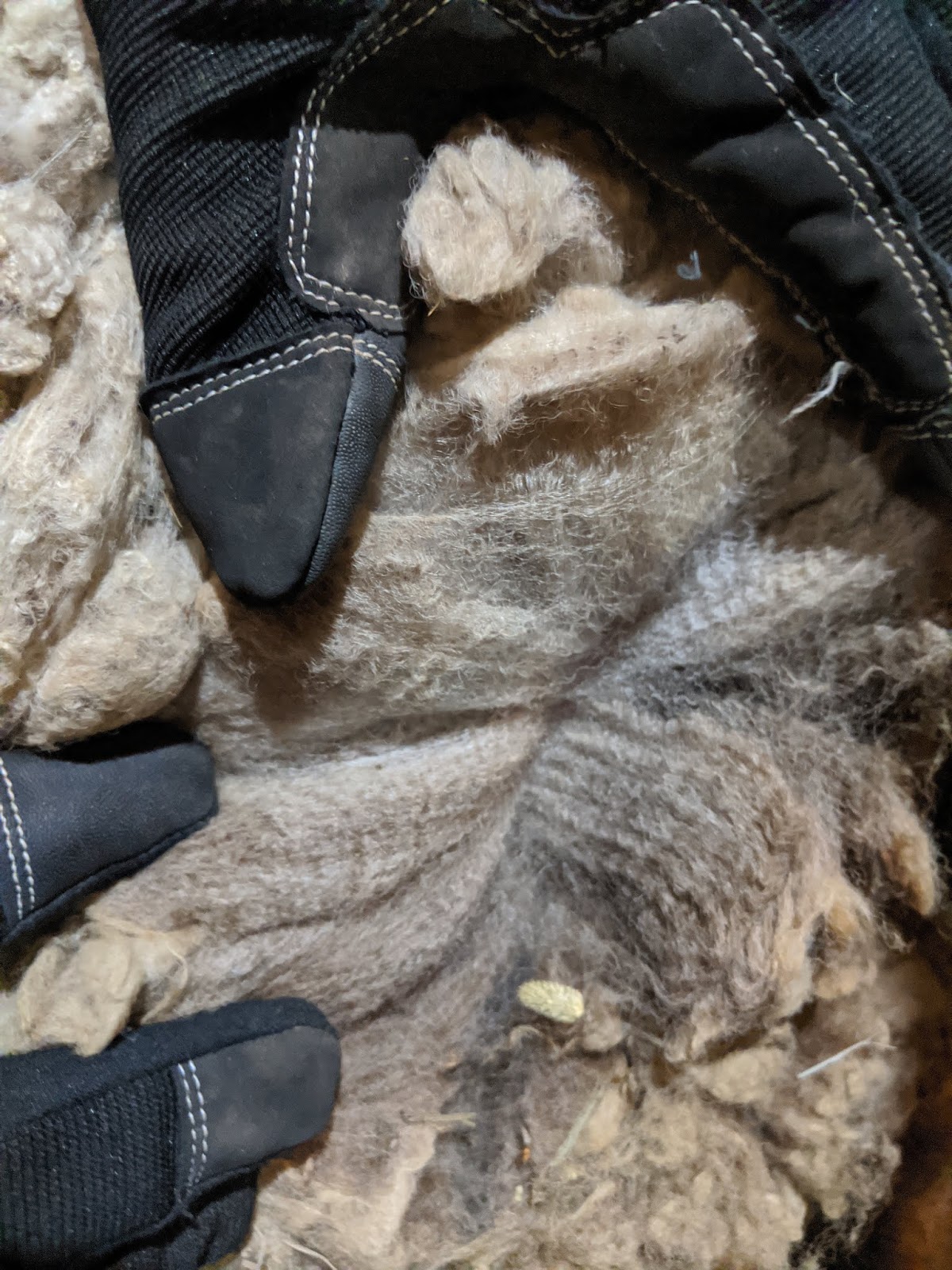
 What you really need to do, however, is part the fleece and evaluate the crimp. Crimp tends to vary based on genetic lines, but there is a high correlation between fineness and crimp. Once you get to know your sheep, you will know whether your fineness holds well just be evaluating the crimp. That’s not to say you can tell how fine the sheep is by looking at the crimp. Crimp is hereditary. I’ve seen finely crimped Shetlands that are coarser (relatively speaking) than another one that has bolder crimp. But when you are in the middle third of each fleece, you shouldn’t see a dramatic change in crimp size as you move to the back. This is what people mean when they say a sheep falls off in the back. Now we are into the back third of the sheep.


You will almost always see a larger crimp structure when you get to this part of the sheep. As I have said previously, however, you should not see a completely different fleece type here. At most, you should see a one grade change when you get to this point compared to the middle third right before it. It should not feel coarse. All of these comments exclude the britch, which admittedly is part of the rear third, but is always skirted out. Finally, we have the britch.


We do not have extreme britch examples to share with you or I would. What you will notice here is that the britch still has crimp and a defined lock structure. It is not hair, in other words. If it was hair, it would have a long tip extending past the main fibers, there would be no crimp, and it would feel coarse. This does not. It is noticeably different than the rest of the fleece, but still very much “Good” Shetland. I am not saying every Shetland should have a fine britch wool. I am saying it doesn’t matter what the britch is like since most people skirt that. I am also saying that the britch has to be limited. If you are in the hip area and have very straight, coarse fiber, you have a fleece that will have to be separated into its various grades and processed accordingly. You are not going to produce next-to-skin yarn from this condition. We tend to skirt pretty heavily in the britch area because it is heavily contaminated with VM, but much of it is very good fiber.  We have started sending our britch wool to the mill to process into yarn.  Before we were at this level of quality the britch wool would just go into the compost pile.

That’s pretty much the nickel tour of fleece variability. I don’t like to see a dramatic loss of crimp in the back third, but it’s not uncommon.