Showing posts with label sheep. Show all posts

Friday, September 25, 2020

Everything I can think of to tell you about the Majacraft Little Gem Spinning Wheel

The Little Gem from Majacraft is positioned as the travel wheel in their Spinning Wheel product lineup.  It is lightweight and takes up very little space.


The Little Gem is excellent for spinning fine yarns, but is able to spin all types of yarn, just like its bigger sisters the Rose, Suzie and Aura.

The Little Gem was launched in 2000.  There is a video interviewing Owen Poad on YouTube where he says it took 3 years to design, and 3 hours to make.  My takeaway from that is a lot of thought went into the design to ensure they achieved the goal to make a small, transportable wheel that could do everything you would expect from their larger wheels with the same precision and quality that make spinning on a Majacraft wheel an absolute dream.

Majacraft completed a redesign in March of 2019.  Per the blog post that announced the change, the some of the upgrades include the following:

  • They moved the tension knob so you could use the standard Jumbo bobbin and associated flyers without changing the tension knob.
  • Moved the stem lock bolt to the front of the wheel
  • Changed the stem lock material from brass to stainless steel to add strength (I read some Ravelry posts where this part was breaking and people were needing to replace it.
  • Changed the pedal shape to standardize with the other wheels

The majority of the wheel is hand crafted from New Zealand Rimu wood.  Rimu wood grows in New Zealand and is sustainably harvested for use in Majacraft products.  The drive wheel is made of bamboo and hard board.  The bamboo is sourced from renewable forests.

The Little Gem uses Scotch Tension to take up the yarn on the bobbin.  This means that the drive band from the drive wheel is directly connected to the flyer via the whorl (aka pulley) - as the wheel spins the flyer spins.  The Flyer spins at a rate determined by the pulley groove you set your upper drive band in, each groove has a calculated ratio for the speed that your flyer will rotate in relation to one turn of the drive wheel.  The bobbin rotates free from the drive band, but is controlled by a brake band that applies tension to the bobbin to control the speed at which it rotates.  The Flyer will rotate faster than the bobbin to apply twist and wind onto the bobbin.  The adjustable brake tension is what controls the speed at which your yarn is drawn onto the bobbin.  Compared with other tension systems (Irish, Double), Scotch tension is known to be better for spinning finer yarns.  The three elements making up the Scotch tension system are the tension spring, tension knob and tension band.  All three of these items can be purchased as replacement parts.

Scotch tension system on the Little Gem

The Little Gem weighs 19 lbs in the package with the accessories and bag.  Once assembled it weighs ~9-10 lbs.  The weight will vary depending on the grain of the wood.  More grain means a heavier wheel.

The footprint dimensions are 15" x 13.4".  Maximum height is 29.1"  The wheel diameter is 11.8".  Orafice height is adjustable - from 27.5" to 30.7".  Its folded height is 5.9".

The ratios you can achieve with the Little Gem are as follows:

Whorl size - 5 is largest ->54321
Standard Pulley4.75.77.59.812.8
Suzie Pulley3.55.37.39.111.6
Rose Pulley (Slow Speed Kit)2.93.84.97.510.2
Fast Pulley8.010.212.115


They say that people have taken the Little Gem onto planes as a carry on item.  People have actually spun on planes and in cars.

The Little Gem has different treadle mechanics from other Majacraft wheels.  The treadles aren't connected by way of rods to the drive wheel.  Rather they work more like pedals on a bicycle which move rollers under the treadles.  These rollers turn a shaft, which in turn rotates a gear which is connected to the drive wheel.  The treadles can lift up off the rollers - which is how you install the lower drive band.  This causes the treadling action to feel a little different from the other Majacraft wheels, but just takes getting used to.  They recommend you shift your feet up on the pedal a little to have the most effective foot motion.

Every Little Gem is tested before it leaves the factory.  A member of the Poad family signs their name on the bottom of the wheel with its serial number before it ships out.  You should register your wheel on the Majacraft Site when you receive it so they have record of where it is and who owns it.  It makes it easier down the road if you need technical support as they will be able to know what revision you have in order to help you optimize the wheel for your needs.  It is also helpful if you need to make a warranty claim.  Majacraft warranty on the Little Gem wheel is 2 years from when you purchased the wheel from me.  It is limited to repair or replacement of defective parts, determined by Majacraft.

The only accessories you cannot use on the Gem are the Overdrive head and bobbin.  You can use the High Speed head, but it won't add any speed to the Gem as the Little Gem already has the ability to move at very fast speeds.

When you order a Little Gem it comes standard with one delta flyer, 3 standard plastic bobbins, a travel case and a 2 bobbin capacity travel lazy kate. 

Travel Lazy Kate is included with the Little Gem

If you require a 3 bobbin capacity Lazy Kate, you can purchase a Universal Tensioned Lazy Kate as a separate accessory.

Majacraft Universal Tensioned Lazy Kate allows for 3 bobbins - can also accommodate Jumbo Bobbins

The Delta Flyer is easy to thread and constructed of stainless steel.  The flyer hook has an 8 mm orifice.  The flyer bar on the Delta Flyer is 4.7" long. For best results with the Delta Flyer, make sure your fiber is drafting at a 90 degree angle to the flyer bar.  If you are drafting from the side of the wheel, you can swivel the head to achieve the correct angle.

Majacraft Delta Flyer with 8 mm Flyer Hook

The standard plastic bobbins are reversible with brake grooves on both ends.  The core has holes so you can submerge the entire loaded bobbin into a dye bath and get full dispersion of dye into your yarn. The bobbin flange diameter is 3.5", 4.5" long, core diameter is .8 " and the bobbin weighs .22 lbs.

New Majacraft Black Plastic Bobbins will come standard with your Little Gem

You can order your Little Gem to be outfit however you like rather than going with the standard accessories.  If you prefer to order with a different flyer or bobbins, just let me know and I will provide you with a custom quote for your requested configuration.  Majacraft is very flexible and open to customizing to ensure you receive the wheel that allows you to "spin your dreams". 

You can purchase additional accessories for the Little Gem, specifically flyers and bobbins.  Not all flyers and bobbins can or should be used together.

The table below outlines the Flyer and Bobbin accessories you can use with your Little Gem with indication for bobbin compatibility in the body of the table.  The flyers are listed in the first column, bobbins along the top, with comments in the table regarding suitability for the bobbin's use with each type of flyer.  Majacraft has simplified the selection process by creating kits for the optimal combinations of flyer/bobbin.  I will write a blog post in the future with very detailed information about the kits available from Majacraft.

Standard Plastic Bobbin
Standard Wood Bobbin
Lace Bobbin
Baby Bobbin
Stylus Bobbin
Jumbo Bobbin
Lace Flyer
Not Compatible, bobbin too large
Best for lace singles
Best for plying lace
Doesn't have a flyer
Not Compatible, bobbin too large
Delta Flyer
Compatible
Compatible
Can be used but not optimal
Doesn't have a flyer
Not Compatible, bobbin too large
Fine Flyer
Compatible
Compatible
Can be used but not optimal
Doesn't have a flyer
Not Compatible, bobbin too large
Hybrid Aura Flyer
Can be used but not optimal
Doesn't have a flyer
Compatible
Wild Flyer
Can be used but not optimal
Doesn't have a flyer
Compatible
Plying Flyer
Can be used but not optimal
Doesn't have a flyer
Compatible


The Little Gem has two drive bands.  There is the drive band that connects the pedals to the drive wheel.  When reordering this band it is called the Little Gem Lower Drive band.  This band is thicker (4 mm diameter) and shorter.  There is also a band that connects the drive band to the flyer whorl (2 mm diameter, 43.3 inches long).  This is called the Little Gem Upper Drive Band.  When you ply with the Little Gem you cross the upper drive band rather than reverse your treadling.

You can adjust the height of the Little Gem by loosening the wooden lock knob on the stem and easing the entire spinning head upwards.  You can also adjust the direction the head face if you like to draft off to the side of your wheel.

The recommended retail price on the Little Gem is $1,190 USD.  If you decide to tailor the accessories, we can reprice it accordingly.

Links/Resources:

Purchase a Little Gem

Majacraft Little Gem Live Stream Video

Majacraft Little Gem Assembly Manual

How to change the lower drive band video

Little Gem Maintenance Video

Plying with the Little Gem Video

Wednesday, June 17, 2020

Everything I can think of to tell you about Sheep Coats

So I woke up at around 3:30 am last night (to pee of course) and couldn't get back to sleep.  I knew by 4 that I wasn't going back to sleep, and that I was up for the day, so said screw it I am washing the sheep coats.  

We took the sheep coats off at shearing in mid April, and I've been hesitant to go to our 24 hour unmanned laundromat due to Covid-19.  I figured one of those mornings when I couldn't get back to sleep I could run up and get them washed and dried in the wee hours when no one is around.  Well yesterday was the day.

Loaded up the van and grabbed a bunch of singles from my fiber festival change till, and drove off in the dark to our quaint little village laundromat located about 250 yards from the Erie Canal. 


Middleport is on the Erie Canal between Rochester and Buffalo

 
As expected, it was nice and squeaky clean and there was no one around.  A little creepy, but cool to be doing something so outside the routine.  Ended up using 3 machines to get them all done at once.

I got them home and decided to sort them and take an inventory, to see how we are set for this year's combination of ages and sizes.
Washed coats sorted into piles, Rich made a handy reference for sizing/colors

Every year the flock is a little different with sizing - lambs, yearlings, adults and the nursing home set have all got different builds, requiring a different size coat.  So not only do we need enough to transition through 1 year from (usually 2 coats per ewe as the fleece grows) we have to have enough to cover the combination of frame sizes also, and the mix is always different one year to the next.

They come in many different sizes, we order from Rocky Sheep, and they have tailored a line for shetland sheep to meet the smaller size requirement.  Rich made a chart to help us know what size to upgrade to as the fleece grows, they put colored tabs on the coat so you can match up the size.  

This is the orange size 25"

Their site has a ton of information on the benefit, ROI and quality of their coats - we agree 100% with all their claims.  Isn't it nice to find vendors you can trust to do and be exactly what they say they are?

They cost around $25 each, plus shipping and here is our inventory:

 Color Size Qty
 Blk/Blu19 5
 Gold2114 
 Silver23 15 
 Orange25 15 
White 27 34 
 Red29 23 
Green 31 9 
Navy 33 2 
   117


117 coats at ~25 each, we've invested ~$3000 in coats to keep our fleeces nice and clean.  Every ewe on the farm gets a coat.  Right now we have 52 ewes, 16 of them lambs, so probably going to have to invest in a couple more as every year the mix is just that different.

I don't know how long coats last, Rich has been managing that, I don't think we have tossed any out.  Some have gotten ripped, I don't sew, so we use those usually on the nursing home set.  We have been coating for a few years so I would say they last a good 5 years if not more?

The size refers to the length of the coat/body.

Many people think they are to keep the sheep warm, but they aren't.  They are designed to keep the wool clean and free of VM that can either destroy a fleece, or greatly reduce its value to a spinner, or add additional processing cost if you take your fleece(s) to a mill.

Very proud to be able to offer such clean raw fleeces to spinners


When I corral the ewes into a small area of the barn and they have their coats on, it makes a very soothing swishing sound like in this video:


We put them on before we start hay in the fall, so they don't have them on over the summer when they are on pasture.  We have tried all sorts of feeders and methods, but in the end we feed hay off the ground.  Its going to get in the wool either way, especially the lambs and yearlings as they are underfoot, and of course they have the nicest wool.  Sometimes we'll catch taller ewes eating hay off the yearling and lamb backs, but that isn't and effective method to keep vm out of a fleece.


The coats come off on shearing day, and then we bag them up.  When things settle down after lambing, they get washed, sorted, inventoried and then packed into clearly marked bins in the garage.

After shearing they go in bags to store until washing


Ahhhh.  Nice and organized in bins by size.

Once in a while when we sell a sheep, we will sell the coats along with, usually if the customer is a spinner, they appreciate not having to deal with sizing and ordering.

We didn't use coats for a long time, but decided after an embarrassing fleece show at Rhinebeck where practically all my fleeces got set under the table for excessive VM, that it was time to get serious and coat the girls.  I am so glad we made the decision, it has greatly improved my enjoyment of processing the fleeces, and I am very comfortable and yes, proud to be able to offer such a high quality product to my spinning friends.

The neck and britch aren't covered, so I set those aside during skirting.  When I sell a raw fleece, I only sell the portions that are under the coat, so the fleece is nice and clean.  Cleanish britch with tags removed goes to the mill sorted by color for my millspun yarn.  

A skein of millspun yarn from fawn skirtings

Neck wool I pool and hand flick and process into batts on my drum carder for spinners to enjoy.

Hand washed, flicked and drum carded batt from luxuriously soft neck wool

Someone asked me if we have problems with lambs getting caught up in the coats when the moms have coats on, never had that issue thank goodness.  We do make certain the coats are fit nice and snug, but not too snug as we don't want to smash the fleece.

Susan with her lambs, looking elegant in her coat


I did something a little different this year as I had the time to roo a good number of ewes.  I started rooing before shearing and was nervous about putting a rooed ewe back in with the flock.  The reason for this is that the sheep don't recognize the shorn ewe as one of the flock.  They identify her as new, and she will get bullied a little bit, and I hate that.  Nature can be cruel sometimes.  Anyways, the way I got around this issue was I only rooed what was under the coat, and then put the coat back on over the rooed part!  This way she appeared from the outside to look and smell exactly the same, and it worked beautifully!  The coats came off the rooed ewes on shearing day, and the neck and britch I did after shearing at my leisure, and by then, they were outside much of the day, distracted by the sun and grass.  So that is another great benefit of the coats!

We never had an issue with felting or mold, I will say when we used to submit our fleeces in shows, ocasionally the judge (LK) would fault us for clumpy tips, as the normal tips on the shetland fleeces get kind of blunt under the coat.  

 I don't mind this, as I really think the best processing for a fine shetland fleece is combs or flicking, and it comes off the same either way.

I flick washed locks with my Majacraft Flick Carder to open up the tips - click this link for the Youtube Video of me flicking

That's pretty much the lowdown on our coats.  We put a lot of effort into a great product.  If you have sheep, and spin or sell wool, I strongly recommend you take the leap to coating your sheep.

Saturday, January 18, 2020

Tour of a Shetland Fleece

I said in a previous post that I wanted to break down a Shetland fleece from front-to-back in order to give everyone a better perspective on what to expect. One thing that I need to say at the start is that all sheep fleeces are finer in the front (specifically, the neck area) than they are in the britch area all the way in the back. I have tested a few fleeces over the years and found that the difference could be as small as two microns, but it’s there nonetheless.

Whispering Pines Neda - the model for the photos in this post.  She is a 2018 ewe.
We don’t spend a lot of time worrying about the neck wool because it is the part that is not covered by our coats and is always loaded with VM. Therefore, this gets skirted and collected for handprocessing (which, quite frankly is how I think all neck wool should be handled since it is the finest the sheep has and should be treated like gold). Here is an example of what neck wool will often look like in a Shetland.


You can see very fine crimp. Just like with britch, we don’t micron test the neck wool, so I don’t have data on it, but I can say that Neda has an average micron value taken at mid-side (the infamous last rib) of 23 microns.

The VM isn’t too bad yet at this time of year. Next is the shoulders. Not as fine, but still superfine.


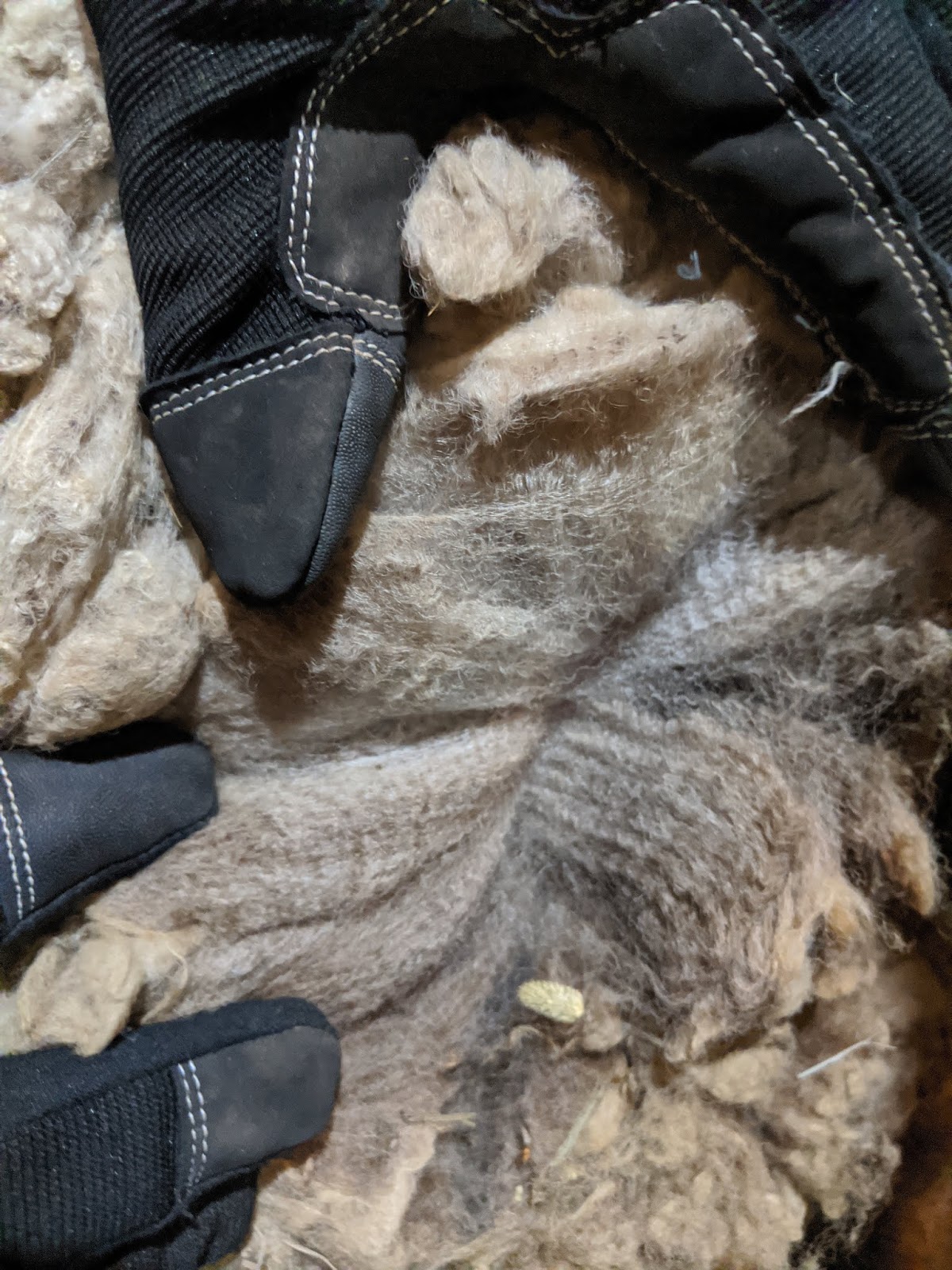
Next is the middle third. I have three different sections photographed here going from front to back (right in front of the hips). The middle third needs to be consistent from the front to back because that is where the micron test was performed and that result needs to apply to the entire thing. When you feel the middle third fleece on most if not all of our sheep, you won’t notice a difference in softness as you move backward.

Middle Front

Middle Front

Middle Middle

Middle Middle

 What you really need to do, however, is part the fleece and evaluate the crimp. Crimp tends to vary based on genetic lines, but there is a high correlation between fineness and crimp. Once you get to know your sheep, you will know whether your fineness holds well just be evaluating the crimp. That’s not to say you can tell how fine the sheep is by looking at the crimp. Crimp is hereditary. I’ve seen finely crimped Shetlands that are coarser (relatively speaking) than another one that has bolder crimp. But when you are in the middle third of each fleece, you shouldn’t see a dramatic change in crimp size as you move to the back. This is what people mean when they say a sheep falls off in the back. Now we are into the back third of the sheep.


You will almost always see a larger crimp structure when you get to this part of the sheep. As I have said previously, however, you should not see a completely different fleece type here. At most, you should see a one grade change when you get to this point compared to the middle third right before it. It should not feel coarse. All of these comments exclude the britch, which admittedly is part of the rear third, but is always skirted out. Finally, we have the britch.


We do not have extreme britch examples to share with you or I would. What you will notice here is that the britch still has crimp and a defined lock structure. It is not hair, in other words. If it was hair, it would have a long tip extending past the main fibers, there would be no crimp, and it would feel coarse. This does not. It is noticeably different than the rest of the fleece, but still very much “Good” Shetland. I am not saying every Shetland should have a fine britch wool. I am saying it doesn’t matter what the britch is like since most people skirt that. I am also saying that the britch has to be limited. If you are in the hip area and have very straight, coarse fiber, you have a fleece that will have to be separated into its various grades and processed accordingly. You are not going to produce next-to-skin yarn from this condition. We tend to skirt pretty heavily in the britch area because it is heavily contaminated with VM, but much of it is very good fiber.  We have started sending our britch wool to the mill to process into yarn.  Before we were at this level of quality the britch wool would just go into the compost pile.

That’s pretty much the nickel tour of fleece variability. I don’t like to see a dramatic loss of crimp in the back third, but it’s not uncommon.

Saturday, November 16, 2019

What I am Working On

Got to spend a little time in the barn with the girls this very cold Saturday morning.


Still flick carding Soraya - about halfway through.


Here is the first plied skein from Soraya, almost iridescent!


Next on the wheel will be the gradient yarn from Cersei


Decided to make batts with the carded locks left from Georgianna, these will be heading to the etsy shop soon.


These yarns are on deck for washing and thwacking today.  L to R we have the Rhinebeck skein, 2 full skeins of Georgianna and 10 small skeins for the sheep heid kits, 10 small skeins of Soraya also for sheep heid and one full skein of Soraya.  They are in the utility tub now for the soapy soak.


Hazel is still on the needles, here I am knitting continental and feeling very sophisticated.  At the airport Monday night waiting to leave for a business trip.


Made a video last weekend to demonstrate my method for flick carding a soft shetland wool fleece:


I need to find a pattern for my millspun yarn ends.  Would like to have a demo of something knit up with my millspun yarns and then feature the pattern.  Something small like a cowl or hat or fingerless mitts.  Any ideas?


Saturday, November 9, 2019

What I am working on

That blue grey light of an overcast winter day


I am working on finishing carding Cersei's wool to make a gradient yarn.  Maybe a couple skeins as it looks like I am getting a lot of flicked locks from this fleece.


I finished plying a solid skein from Georgianna's Shaela fleece.  Was surprised to find that she has many shades of grey in her fleece so I will be spinning a very subtle gradient skein from her gun metal grey beautiful wool.


I washed Soraya's white fleece last weekend, so will begin carding and spinning her wool which will go into the sheep heid hat kits, a couple skeins of self striping yarns, a couple batts for my spinner friends and a skein of yarn.  Its a lamb fleece so I am being a little ambitious with my expectations, but she has wonderful length so I am hopeful I'll get some decent yardage from her.

She looks bumpy because we had already coated her, then removed the coat to take her photo.  You can see the outline of the coat where the wool isn't covered.


On the needles still is Hazel's fiber from a skein of yarn that didn't sell at this year's fiber festival junket.  Want to have an example of her knit up for next year's booth display.  I am trying to knit continental when I can, but if watching tv I will go back to my method I was taught by Grandma Frey to throw over the needle.  Wasteful, but I can do it without paying attention.  I have to travel for work this week and will be a passenger for some long parts of the trip, so will have plenty of practice time to get more automatic with a continental knit method.


These are the needles I got at a flea market last summer I think they're really pretty


Will be washing Fanny's fleece next for a custom request for batts.


I watched a great doc this week on PBS POV, about a family dairy farm, sharing trailer here.  Lots of pretty farm scenes and kids doing chores.


Also watching "Press" on PBS, its really good.