Wednesday, November 11, 2015

Ewe-A-Day - Whispering Pines Pearl

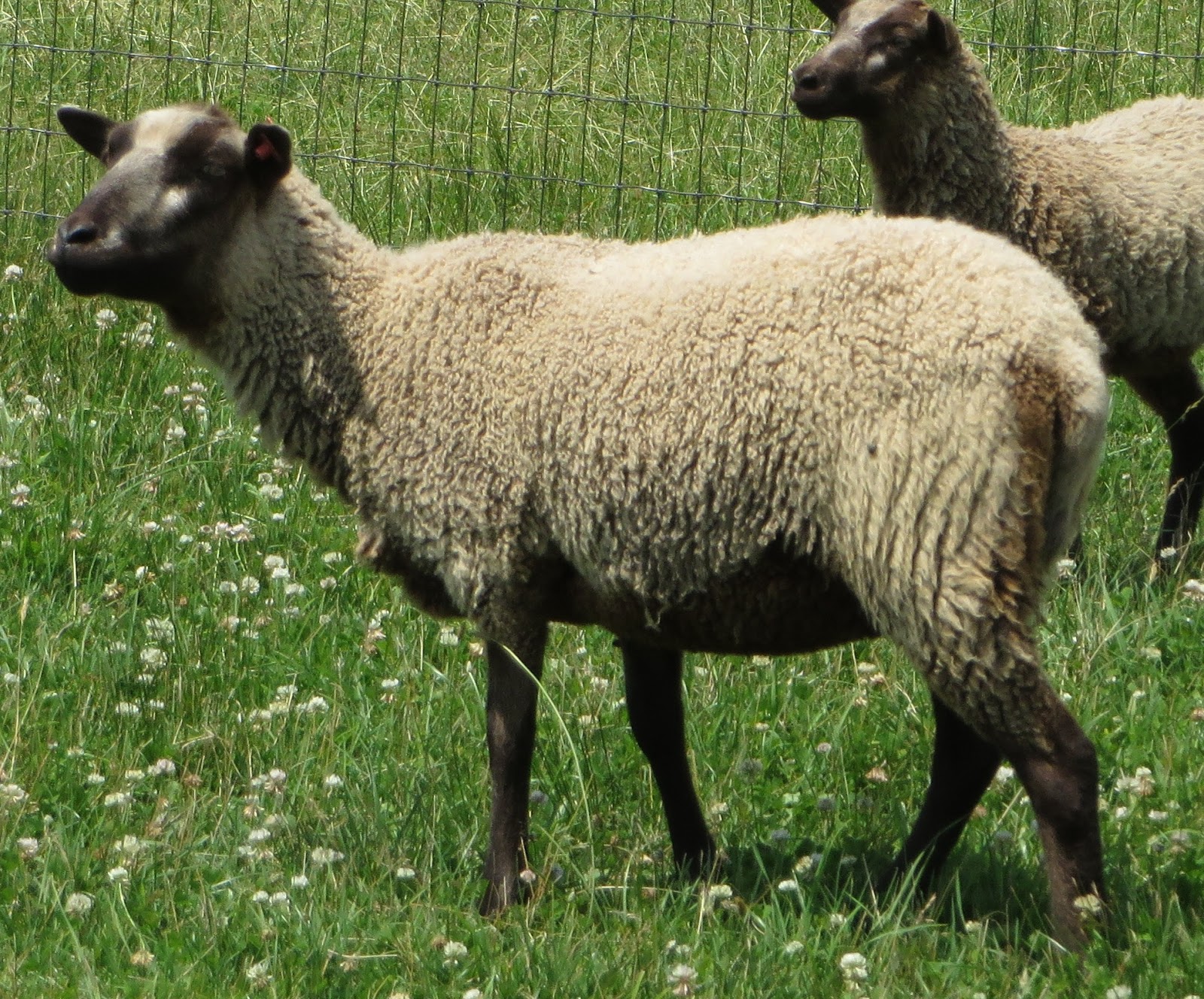
Pearl remains one of the best Shetlands we have had born here on our farm. She is out of Wintertime Bond and Itasca. Why I only bred those sheep together that one year, I’ll never know. There are times when I want to repeatedly slam my head in a car door for some of the decisions I have made over the years and this is one of them. Fortunately, 99% of my breeding decisions turned out for the best, so I can’t complain too much.


Her fawn katmoget daughter above to her left.


Part of her grey katmoget daughter to her right (above and below). Both out of Egyptian Autumn. Egyptian Autumn is out of Blue Sapphire and Egyptian King. We have had good luck with the Jericho and Pompey crosses, and this is another one. Blue Sapphire is out of Blue's Clues and Bond is a Pompey grandson. Egyptian King was Bond's son. Blue's Clues was out of Wintertime Blues, who was out of Jericho. It takes a while sometimes to start getting offspring that realize the potential of a particular ram and ewe, which is why I always look several generations down the road when I choose breeding groups. I've heard it said that it often times isn't the F1 sheep that realize your vision, it's the F2 or F3's. That's what I've noticed also. I don't know that her daughters will be better than her (or Egyptian Autumn for that matter), but I do expect that their offspring will be. Both daughters do have nice fleece length, however, so I am excited to work with that as well.


Pearl’s five year old fleece stats are: 25.2/4.4/17.3/7.5/23.8. Those are fantastic numbers for a five year old, but it’s not our favorite fleece in the flock. Again, an SF of 23.8 is very rare for a Shetland of her age.

The important thing is that she has been an incredible producer of future talent. She will most likely end up being most famous for being Canterbury’s mother, but she is one of the better Shetland ewes around on her own merit.
She is also one of the first Shetland ewes we have had possessing a head that I really like. Not that it's necessarily better than other sheep in our flock, but I do like it. Bond had it, and Canterbury does as well. Some of Canterbury's lambs also have it. I think Pearl is also a good example of what you can do with careful breeding. Itasca is our largest Shetland, and Pearl is very fine boned and right in the sweet spot for what I like a Shetland to be. She is also the first truly fine Shetland we have had born here. Her fleece was so soft and unlike anything else we had ever seen.

Tuesday, November 10, 2015

Ewe-A-Day - Blue Sapphire


Blue Sapphire has always been a flock favorite and we are excited to get black-based sheep out of her next spring if we can. We have several of her offspring in our flock and we have sold several of her excellent sons. Egyptian Autumn was one of those sons and I believe he is one of the best rams around. Blue Sapphire is out of Sheltering Pines Onyx Velour and Sheltering Pines Blue’s Clues, who was an F2 Jericho. Great fleece on this ewe! I can honestly say she is one of the best Spotted Shetlands I have seen, and I am glad we have been able to keep several of her ewe lambs. Her fleece stats are: 26.7/4.6/17.3/8.3/25.2.
This is a classic example of why I rely so much on the SF. Sapphire’s SF is 25.2, which seems to match what her fleece feels like. If one were to only look at her average of 26.7, it might not stand out. Of course, she is 5 years old...and spotted. A few years ago, we were lucky to have two year old ewes with fleece numbers like that. As I will say more than once in this series of posts, the average micron isn't the Holy Grail. I've had lower averages than hers, but it's the handle that matters, and hers is excellent, as the SF suggests. I'd like to have a few more like her.
Not much to fault with this ewe.

Monday, November 9, 2015

Ewe-A-Day - Itasca

I think Shetland Sheep breeders tend to like their flocks regardless of whether their sheep are good, bad, or average. After visiting 16 flocks, that’s my take away. What excites me are the flocks that are taking an analytical approach to where they are and making adjustments based on the results. That’s really the most fundamental step to any improvement initiative.

Having done that with our flock every year since at least 2005, I can honestly report that the Whispering Pines flock is still a work in progress, but I am very bullish on our breeding program. Over the next few months, I am going to provide data and analysis to back up my good feeling. We are not exactly where I would like to be against all of our goals, but we have exceeded many of them in 2015.
I did not believe we could make the kind of progress that we've made over the past four years or so. In many ways, managing our breeding program is like managing a sports team. You plan and constantly redo the roster, but at the end of the day, things don't always go as planned, and sometimes it seems like you have more losses than wins, but if you look at it objectively, you can see the progress. All of the sheep that I am going to share are fantastic Shetlands. Some people will prefer this one over that one, or maybe even some of their own sheep over ours, but I can promise you one thing. Every sheep in these posts is excellent and they produce! I will sell sheep that don't produce consistently, and I will sometimes keep a lesser ewe who does produce consistently. Why? Because I'm not breeding for now, I am breeding for the next few years. I am breeding toward sheep that are even better than what we have today.
I have developed a new way to quantify our sheep based on where I think they are relative to 1927 Shetland Sheep standard. That is a bit of a flawed approach because all breeders seem to be making claims about how well their sheep meet that standard, and clearly not all are doing that very well. I have been trained to that standard by certified Shetland Sheep Society Inspectors/Judges. There are only a handful of breeders in North America who can make that claim. That doesn’t make me more knowledgeable than those breeders, but it does provide a point of reference in terms of the claims I’ll be making. People who have not been trained to any standard can’t really be making valid claims about that standard. That applies to all things in life where standards exist. Personal preferences are a different thing altogether. People have a right to like what they like, however, and I respect that. I'm merely pointing out that the sheep on this list are part of our flock because of what they bring to the table in terms of genetics and fleece quality. They are the best of the breeding we have been doing since 2001. I have heard people say that Shetlands are a primitive breed and as such, should not be improved. Those are personal opinions, but I can tell you this. Shetlands in this country had to be improved. They had to be improved because the breed had deteriorated so badly since they were first imported. So, I don't look at as improving the breed as much as bringing them back to what they once were. Our goal here at Whispering Pines is simple. It's to restore the Fine Fleece Shetland to the place it once held as the "Finest of The British Breeds." These ewes are a result of that lofty goal, but they are the foundation for what is to come.
I’m going to start this year’s ewe-a-day marathon with the oldest ewe followed by the youngest.


Wintertime Itasca is one of two black ewes that we have and she is also our largest ewe. Her fleece is very good, but certainly no longer what we are breeding for. Whether it’s because she is black, or because her CV is relatively high, I can’t say. What I can say is that she is a producer. Wentworth is out of her. Pearl is out of her. And Treviso is her daughter as well. And that doesn’t include some very nice Shetlands that we don’t own anymore. I can’t think of a lamb of hers that we didn’t like. This year, we will be looking for her to produce either fine blacks or dark katmogets. I’m also thinking about putting her with Canterbury because of his finer bone and overall fineness, but I’m not sure that would be the best cross conformationwise. I did put her with our F1 Jericho ram one year and loved the results from a conformation standpoint, but the lamb fleeces weren’t as fine as I would have liked. Good base hits, but not homeruns in the fleece department. I have several good options that I think will bring out her best one more time.
Itasca’s fleece stats are very respectable for a 7 year old Shetland who eats everything in sight: 24.7/5.8/23.5/10.3/24.6.
As I have said previously (and will say again), I don’t like the higher CV’s and hers is 23.5%. But at the end of the day, her SF is 24.6, and that puts her in elite territory for her age. She is a good example of why I always say there are multiple ways to meet the 1927 breed standard. Her fleece is superfine and well within that 3"-5" sweet spot. Her fleece is crimpy and dense as well. The rest of my gripes are a matter of personal taste. I also love the wool on the poll.
I am also going to mention nutrition a few times during these posts, and Itasca is a good example of what I am going to say. She is fat. Our pastures this year were very lush and I am seeing it in the growthiness of the lambs and yearlings. I also see it in the lamb micron stats.
One last story on Itasca. I still remember the day I put her, Bond, and Blue's Clues on the truck at Stephen Rouse's house so many years back. I still remember Bill Stearman looking at her and Bond and whispering in my ear something to the effect of, "God forbid you breed him to her." I was thinking about doing that, but hearing it from Bill confirmed that was the right thing to do. It always pays to listen to people who know more about the breed than you ever will. Even if they are Canadian...LOL. That breeding that year gave us Pearl, who ultimately gave us Canterbury. You never know where breeding decisions are going to lead, but it's nice to get homeruns now and again.


Thursday, October 1, 2015

Fiber progress

During the fiber festivals, I demo flick carding and spinning.  I pull locks from a washed fleece, flick them and spin them up.  

Blue Sapphire's fleece was selected this year because it is so pretty and has beautiful lock structure and I love spinning her.

Anyways, plied last weekend, and ended up with two dreamy creamy skeins with a little bit of grey flecks every so often to pay homage to her grey spots.


Also carded those cobwebby locks from Pamela, yielding beautiful cloudy carded locks like this.

Which spun up into nice singles.  I have 1/2 a bobbin of cream colored which i selected from her fawn katmoget fleece.  The plan is to fill a second bobbin with the same amount of white, and then do a gradient down to the darkest color from her neck wool, so the yarn will make a pretty transition from creamy white to rich cocoa brown. 

This makes really cool hats if you start with the dark around the brim, then lighter up to the crown.  Maybe I'll turn this into hat and then blog it.  Just decided, yup, that's the plan.

Wednesday, September 23, 2015

What I am Working On

Just washed Pamela's fleece.   Pamela is a 2014 lamb, all ewe lambs from 2014 Rich named for songs with girl's names.  I don't know what song Pamela is, but I love her fleece. She is a fawn katmoget, and is very soft and crimpy.  She is out of Frangelico and Egyptian Autumn.

Lock from Pamela's washed Fleece

I probably won't get to carding it until Sunday, after the WNY Fiber Arts Festival.  I am almost as excited about carding her fleece as I am about the fiber festival!!

Pamela

I am currently spinning Blue Sapphire's fleece from 2013.  She was 3 when she donated this fleece, and it is still so very soft, feels like a lamb fleece.  I already spun up her grey parts and used for my sheep heid kits.  The white is really pretty, with intermittent flecks of grey.

Blue Sapphire's Wool on Hoof


Blue Sapphire and her flashy ram lamb

Monday, September 21, 2015

Fingerlakes Fiber Festival

This past weekend was the Fingerlakes Fiber Festival at the Hemlock fairgrounds.  It was so fun, really great to see all our fiber friends and talk about their projects made from our soft shetland wool.  Thank you to all for your support and kind words about our soft shetland wool!


Friday, July 3, 2015

2015 Sales List


The following Shetland Sheep are available for sale in 2015. The buyer can reserve any of these sheep with a 50% non-refundable deposit. Delivery, health papers, and any other costs associated with transporting them from Whispering Pines Farm to the buyer’s location is the sole responsibility of the purchaser. Whispering Pines Farm will pay for transfer, and/or registration costs in NASSA.

All of these Shetlands are graded with the FFSSA grading system that is based on the Jamieson and Smith system from Shetland. I have done my best to evaluate the fleeces using both my own experience as an evaluator and micron data. We send fleece samples annually to Texas A&M for analysis. The micron data provided for each sheep is from 2015.

All of the sheep are super fine except for two, but those two sheep have fleeces that have been very popular with spinners and I can promise that they will be some of the top examples of the breed you are likely to find.

EWES

Sheltering Pines Constantinople: Fine Price: $250

This grey katmoget ewe is out of Sheltering Pines Starry Night and Sheltering Pines Salicional. She has been with us since she was a yearling and has always held her weight well, and is an excellent mother. She is above average for size, with a weight of about 100 pounds. She also has large fleece that I have graded “Fine” per the grading system.


Micron: AFD: 26.7/SD: 5.7/CV:21.2%/CEM:10.6/SF:26.0/Staple Length: 3.5-4.5”/Age: 7

This is an excellent ewe that is a proven producer.

Sommarang Ilke: Super Fine Price: $250

Ilke came to us from Wisconsin in 2011 (as a lamb). She is about average in size for a Shetland, around 80 pounds. Ilke is a rich moorit who has produced excellent lambs who share her traits. She has a beautiful, typey Shetland head, and carries a “Fine” fleece grade at four years old. Her average micron qualifies for “Super Fine” status. Her fleece is very soft and she carries spots.


Micron: AFD: 24.1/SD: 5.9/CV:24.5%/CEM:11.2/SF:24.2/Staple Length: 3.0-4.0”/Age: 4

Yes, she is the finest ewe on this list! Impressive for a four year old Shetland.

Whispering Pines Blue Diamond: Fine Price: $350

This five year old spotted fawn katmoget ewe is an excellent producer with an equally impressive fleece. She has an outstanding bloodline out of Sheltering Pines Blue’s Clues and Sheltering Pines Constantinople. She is one of the better spotted Shetlands that I have seen and her fleece grades out as “Fine.” You won’t find many spotted Shetlands with fleeces like this one.


Micron: AFD: 27.1/SD: 4.7/CV:17.5%/CEM:8.0/SF:25.7/Staple Length: 3.0-4.0”/Age: 5

Whispering Pines Kahlua: Super Fine Price: $375

Kahlua is a beautiful moorit out of Wintertime Grasshopper and Winter Sky Vogue. What you have here is several generations of “Super Fine” in her pedigree, and she is as well. She is three years old and everything she has produced has been “Super Fine.” I personally think this is the best handling moorit fleece I have seen. The only downside is that the fleece is on the shorter side (2.25”-3.0”). We are currently retaining two of her daughters, which is why she is for sale. She also carries spots!


Micron: AFD: 25.0/SD: 4.0/CV:15.8%/CEM:6.6/SF:23.6/Staple Length: 2.25-3.0”/Age: 3

Whispering Pines Venice: Fine Price: $350

This fawn katmoget ewe is excellent, but we have a number of great fawn katmoget ewes, so we are forced to part with this some of them. Notice the really low SF, which is a good indicator of the handle. Great fleece!


Micron: AFD: 27.3/SD: 4.2/CV:15.6%/CEM:7.0/SF:25.4/Staple Length: 3.0-4.0”/Age: 2

Whispering Pines Cordovan: Fine Price: $350

This deep, rich moorit two year old is a superb Shetland, who had two of our favorite lambs this year (her first lambing). She is out of Khan and Whispering Pines Siena (who we still own). She doesn’t quite qualify for “Super Fine,” but we just sold some of her yarn and it was absolutely fantastic. She also carries spots. These ewes with the super low CV’s really are quite remarkable, traits that were passed on to her lambs this year.


Micron: AFD: 28.6/SD: 5.0/CV:17.4%/CEM:8.6/SF:27.0/Staple Length: 3.0-4.0”/Age: 2

Whispering Pines 99: Super Fine Price: $400

This is a rare opportunity to own a Super Fine spotted fawn katmoget ewe. This ewe is only a yearling, yet is already showing great fleece traits. She is out of Egyptian Autumn and Whispering Pines Irish Rose – a Wintertime Bond daughter. Again, note the very low SF number, which is a good indicator of how the fleece feels. These are great Shetland bloodlines! She is one that we would definitely keep if we had that option.


Micron: AFD: 23.7/SD: 4.2/CV:17.9%/CEM:7.6/SF:22.5/Staple Length: 3.0-4.0”/Age: 1

Blue Diamond Ewe Lambs: Too Early to Grade Price: $400 each

We don’t like to sell ewe lambs this early, but when we put the list together, we decided we had to sell some lambs this year or we’d be forced to sell more excellent breeding adults. I don’t know that these ewes will end up being less than excellent, but there are other lambs and genetics that we want to hold onto, so our hand is forced here. I think both of these lambs are perfect and identical at this point, so I won’t attempt to differentiate them. They are out of Egyptian Autumn, who is both Super Fine and one of the best Shetland rams I have seen in person. This is a great opportunity for someone looking for fine fleeced lambs with bloodlines that will produce.


RAMS

Whispering Pines Oxford: Super Fine Price: $400

This two year old fawn katmoget out of Pompey and Frangelico has been in the “on deck circle” for two years now and since we probably won’t be using him in the next two years, it’s time to see what he can do with an up and coming flock. I believe he will be an excellent flock sire given his outstanding traits. His fleece is “Super Fine” and a bit longer than some of our rams. The length is between 3.5” and 4.5”. Wonderful handle to it as well. Note the 21.9 SF on a two year old ram! Very uncommon and buttery soft.


Micron: AFD: 23.2/SD: 4.0/CV:17.0%/CEM:6.9/SF:21.9/Staple Length: 3.5-4.5”/Age: 2

Whispering Pines Stonehenge: Super Fine Price: $400

This fawn katmoget ram has a very similar appearance to Oxford. Stonehenge is out of Genoa and Khan, however. We used Stonehenge as a lamb and we still have the four ewe lambs that he sired. We were very impressed with him as a sire. His fleece is “Super Fine,” like our other rams and his fleece is just a dream in your hands. I love this ram’s potential as a flock sire, just like Oxford, but Stonehenge is a tad finer. Incredibly fine SF of 19.2 microns.


Micron: AFD: 20.5/SD: 3.4/CV:16.6%/CEM:6.3/SF:19.2/Staple Length: 3.0-4.0”/Age: 2

Whispering Pines Egyptian Autumn: Super Fine Price: $500

This fawn katmoget ram is as good as it gets in a Shetland! His fleece isn’t quite as fine as Stonehenge, but it has incredibly tiny crimp that doesn’t show up well in a picture. He carries spots and has a “Super Fine” fleece. He is out of Egyptian King (a Bond son) and Blue Sapphire (a Blue’s Clues daughter). His fleece is about 3.5” long. He has an incredible fleece for a four year old Shetland! All of these rams are available because we need to do something different with colors.


Micron: AFD: 22.4/SD: 3.5/CV:15.6%/CEM:6.5/SF:20.9/Staple Length: 3.0-4.0”/Age: 4

Whispering Pines Madagascar: Super Fine Price: $400

This “Super Fine” moorit ram is a yuglet out of Winter Sky Vogue and Egyptian Autumn. I like everything about this guy and we may decide to keep him, but we do have a lot of good looking ram lambs this year, and right now, this yearling is available. I don’t believe he will get used this fall, so I’d like to see what he can do with a flock of his own. Incredibly rare bloodlines here.


Micron: AFD: 21.1/SD: 3.7/CV:17.6%/CEM:6.9/SF:20.0/Staple Length: 3.0-3.5”/Age: 1

Whispering Pines Egyptian Sunset: Super Fine Price: $400

Of the many superb ram lambs that we had last year (we had 25 of them), this guy was one of the three that we kept last fall, which should say something about their quality. This ram is out of Egyptian Autumn and Irish Mist (who is a Khan daughter). As fine Shetlands go, this bloodline is pretty amazing! Note the very low SF! We’ve never had one this fine before. You don’t often see Shetlands with SF’s below 19 microns!


Micron: AFD: 19.0/SD: 4.1/CV:21.6%/CEM:7.8/SF:18.6/Staple Length: 2.0-2.5”/Age: 1

Whispering Pines Rosewood: Super Fine Price: $400

This ram’s bloodlines are also fantastic. He is out of Stonehenge and Kahlua, two “Super Fine” sheep. He has a beautiful, soft fleece with very tiny crimp. This guy was a looker from birth. He is a yearling so it’s difficult to project what his fleece will be like a year from now, but he has a lot to offer the right flock. I always like the sheep that are second and third generation “Super Fine,” particularly if they are excellent ambassadors of the breed.


Micron: AFD: 20.4/SD: 3.9/CV:19.0%/CEM:6.7/SF:19.5/Staple Length: 3.0-3.5”/Age: 1

Fleece Terms

AFD (Average Micron):

The average of a sample of fibers measured from the top to the bottom of each fiber. Shetlands are the finest of the British breeds, which means their AFD’s should be much less than 30 microns (the universal threshold for coarseness).

Standard Deviation (SD):

Simply the variation around the average of a sample of fibers. Many Shetland fleeces will have decent AFD’s, but they are actually a mix of fine and coarse fibers, which is revealed in the SD number. We prefer SD’s below 5.0, but we’ve seen excellent fleeces with slightly higher numbers.

Coefficient of Variation (CV):

This is a calculation determined by dividing the fiber variation (measured in standard deviations) by the AFD. This is a critical Shetland metric. Fleeces with higher CV’s don’t tend to hold their fineness into adulthood. We like our CV’s less than 24.0%, but you will find numbers all over the map with Shetlands.

Coarse Edge Mean (CEM):

This is another important Shetland fleece metric because it shows how far from the AFD a second population of coarse fibers is. In other words, the lab calculates the average of the coarsest 5% of the fibers. The difference between this average and the overall sample AFD gives you the CEM. As you can imagine, you don’t want a high CEM because it indicates there are many coarse fibers. Generally speaking, the SD and CV metrics will capture this extra fiber variability, but the CEM provides more information on whether the fibers are simply inconsistent, or whether there are actually very coarse fibers in the sample.

Spinning Fineness (SF):

I like this metric because it is the one that most closely correlates with what my hand feels in a fleece. I’ve seen fleeces with AFD’s of 25 microns that didn’t feel all that soft, and others that felt much much softer than that. The difference is almost always in the SF. A low SF almost always indicates a fine and consistent fleece. I wouldn’t look at this by itself, however, which is why I have also included CV and CEM in our grading system. A fleece could have a low SF, but a high CEM and CV. When I evaluate fleeces by hand, I typically don’t choose the ones with high SF’s, CV’s, and CEM’s. The reason for that is that my hand detects the higher percentage of coarse fibers associated with high SF’s, CV’s, and CEM’s. It’s really the only way to communicate to potential fleece buyers who don’t have the luxury of handling the fleece.